That’s how it is because it’s always been that way. And because that’s how it is, and they know that’s how it is, they don’t need to explain. And because they don’t need to explain, they don’t talk about it, and that’s how it is.
Which makes it hard to explain because it means thinking about what it is. What it is.
And that’s what I lose when I’m away, and what I slip into when I’m back. It’s the pair of jeans that’s stiff for just a moment when first out of the wash but soon soften completely, fitting the contours of the body as a skin. It’s a flicker of unconscious observation that things are the way they always were before falling into a groove so deep that there’s nothing to see without a point of comparison.
Patterns are comfortable, easy, normal. Evolutionary, after all. Patterns have been expected for so long that there might be observations made but no questions asked, at least not out loud. It’s the changes that are questioned, the things that are no longer the way they were before, the things that are just different enough to seem jarringly out of place. And it’s only with comparison that we notice, the comparison brought by distance or time or the dramatic life events that have us seeing everything with different eyes.
I’ve slipped in and out of many skins and they snag sometimes, like the way leather boots rub the backs of heels used to the freedom of sandals. Sometimes a sweater deemed cozy in one environment is garish in another, or a favourite work dress is suddenly completely out of place. Sometimes the clashis obvious, and sometimes it takes a moment to put a finger on just what doesn’t fit. But once identified, it cannot be ignored. The broken zipper catches in all the wrong places and tugging it closed is an inconvenience that turns into irritation.
Late at night is usually the time when everything feels wrong, where the life chosen and celebrated is under the microscope of inquisition, its only fault being that its course is reality and its outcome unknown. (This is living, after all.) The life not chosen, the path not taken, is the one full of possibility and because nothing is known, anything is possible. The life chosen and experienced in medias res suddenly seems written to conclusion. The allure of the other choice is just that, allure, because we can neatly conclude everything when we know nothing. The mind spins patterns and the patterns reveal themselves in stories, compelling for their certainty despite the gossamer substance of dreams.
In the morning it’s easy to see the dreams for what they are, to dissolve the wisps into smoke and settle back down to earth. But what doesn’t go away, what never goes away, is the swell of questions that comes from the lofty heights of comparison. It’s easy to find fault with what there is when what there could be only exists through rose-coloured glasses. And it’s easy to forget that the forks in the road were once obscured with weeds, or that the signs were old and faded. It’s easy to forget that the choice was to walk through the open door because another door had closed. It’s easy to be nostalgic for what is no longer, and easy to fall for what never was and couldn’t be.
It’s having the courage to look forward instead of sideways, to go confidently while the world turns, that is somehow obscured late at night. To commit to what was chosen and to let that path shape itself around a body that has itself changed. The jeans might need to be let out or taken in, held up with suspenders or cut down into a purse, but the jeans shape themselves to the body they’re given; we either fully embrace where we are or run the risk of forgetting to live at all.
And because it always, always helps to remember, here I end with words borrowed:
I shall be telling this with a sigh Somewhere ages and ages hence: Two roads diverged in a wood, and I— I took the one less traveled by, And that has made all the difference. -Robert Frost
One of the reasons I left Asia for Europe was for a better work-life balance, but I admit to uncertainty over what that actually meant. I knew I was looking for something, but I couldn’t articulate precisely what it was. Nevertheless, stating this as a reason for moving in job interviews always led to vigorous nods. Clearly, the work-life balance in Europe was better – but what would that actually look like?
I have often found it hard to judge the amount of “work” I do in the different contexts in which I have taught, not only in terms of the country or age group of students, but also in terms of my career experience. I remember individual lessons taking hours to plan when I was a new teacher, a time commitment that decreased sharply with each lesson under my belt, but twelve years in, I still consistently find that marking a single essay takes about fifteen minutes. As it has been throughout my career, sometimes it is necessary to work late or at home, and sometimes this is a choice. I am juggling arguably more hats now than ever before, but also finding myself less bogged down by minutiae. And after a dozen years in this profession, I continue getting to school early enough to have 40 minutes of prep time before the students arrive – time to drink my coffee, read over my notes, clear my head, and time just in case.
So while I cannot say that my work habits have changed in this search for a better work-life balance, I have sensed a difference in how time is treated. Working in Singapore, the (un)spoken expectation was that people were busy all the time, including on the weekends. In Germany, despite how busy one might be during the week, weekends are a different time and they are meant to be enjoyed. This is not only clear from conversations with colleagues, but also through interactions with students. Rather than asking me if I’ll be available via email over school holidays, my current students ask if they can email me as questions arise and hurry to clarify that they are not expecting answers. I was profoundly touched the first time a student said, “It’s your holiday, too.”
Recently I’ve been talking with a friend about how people in German and American cultures spend leisure time. My American friends often refer to “being productive” or “adulting” (a term I loathe) and my German friends tend to speak in snapshots of specific moments rather than painting a general picture. Unlike when I lived in New York and felt under constant (and unaffordable) pressure to always do something, preferably something new, living in Germany has taught me that all days have something to enjoy, whether they are work days or weekend days. After all, the park is always pretty, even when cycling to work in the rain.
Something I’ve really noticed, however, might have more to do with living in a small town than living in Europe, though I’ve not lived in small towns elsewhere and this is my first time living in Europe. My work-life balance is doubtless better because it only takes me seven minutes to get to work by bike. A trip to the grocery store after school puts me in reach of all other stores I might want to visit, and I’m only five minutes from home. The minimization of commuting time is doubtless significant and provides much more flexibility during the day than I have previously experienced. I do miss certain aspects of life in a big city, but not enough to want to move back to one.
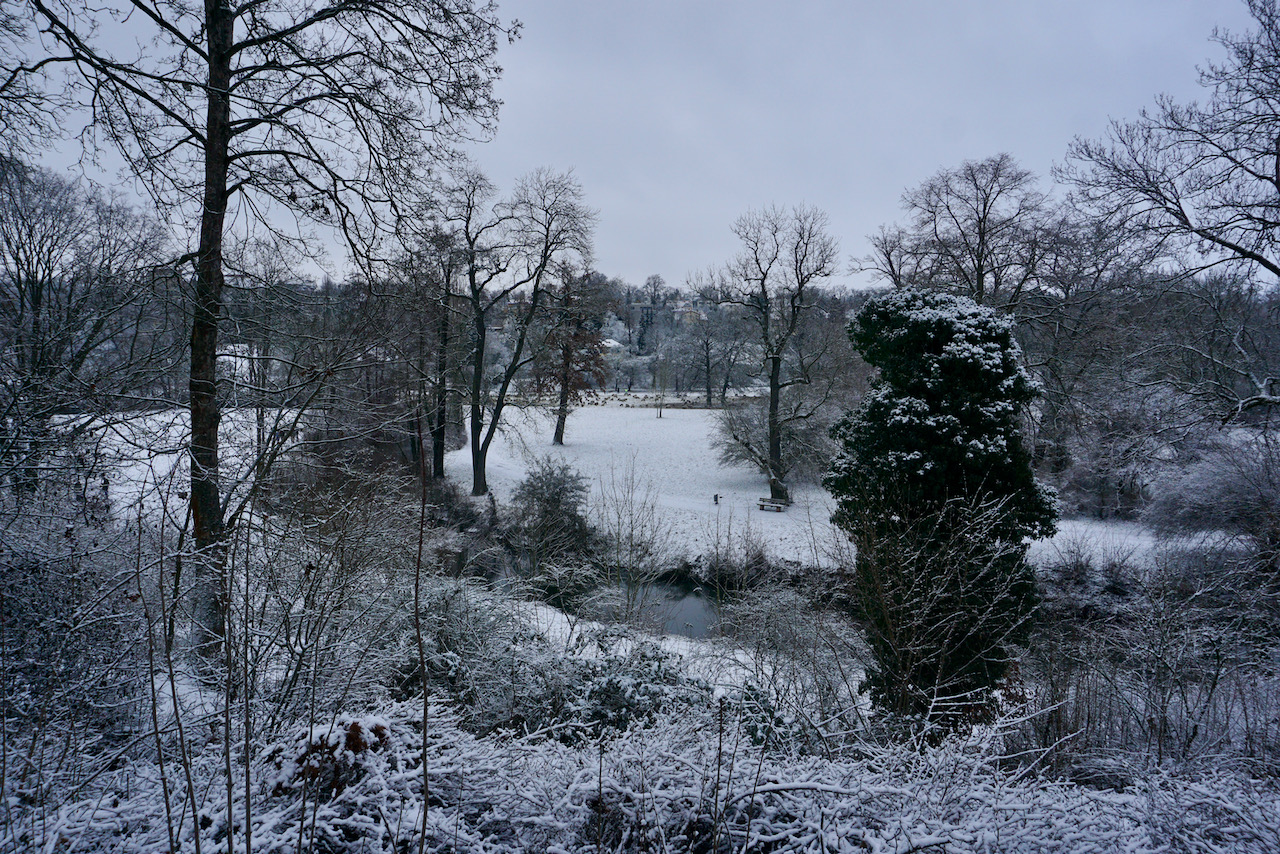
Before moving to Germany, I had a highly romanticized vision of living in Europe in mind: Sitting in the town square and drinking coffee, strolling along cobblestone streets, travelling by train and staring out the window at a green, rolling landscape. After over a year and a half here, I’ve learned that the picture wasn’t too far from accurate: We have cobblestone streets and four town squares, and I have spent time in all of them, sometimes with a coffee; travelling by train is indeed an opportunity to experience a lovely landscape, but also an exercise in patience with delays and missed connections; our park has featured much more in my life that I would have thought before moving here, and just as much as I knew it would upon seeing it for the first time.
While there are certain measurable differences in my daily life now compared to living in Asia, I think there is mostly a different feeling. The expectation of society is not that one works all the time, and the amount of work one does is not a measure of worth, whether self-imposed or through public pressure. This change in attitude has given me space to breathe, to rest, to relax. This is deemed normal, expected, and an important aspect of one’s life rather than a luxury or “waste of time”. There’s balance rather than constant motion, moderation rather than extremity. And perhaps this is what my interviewers with their vigorous nods knew about living in Europe – that I would not find just a work-life balance, but rather a different way of looking at life itself.
The more German I learn, the more I find myself using German to explain new words because the English translation isn’t quite what the word is going for. The feeling or mood of a word can be just slightly different, and this difference can matter. Where this gets interesting are the situations in which German has multiple words to describe an idea that exists quite differently in English, leading me to understand the concept differently in different contexts.
A recent example is that of the word “home”, a favourite theme of mine on this blog. The English “home” variably means house, geographic location, and where one feels a sense of belonging. In German, das Zuhause refers to the place where one lives and feels, as we would say in English, “at home”. I’ve been asked, using this word, where I feel at home, and I often struggle to answer. Based on my understanding of home, in which I am comfortable with “my people” in many environments, I am at home in a lot of places. This explanation causes some bemusement among my German friends, however, because my definition of “home” does not quite match theirs. (Though I’m not certain my definition of “home” matches many definitions at all.)
The other type of German “home” is das Heimat, often considered an untranslatable word. It refers to where one grew up and the connection to place, roots, or culture that exists there. This is an emotional concept, as I understand it, and I’m not sure a similar idea exists in English. Perhaps the closest is “home town”, by which people refer to the physical location where they grew up, regardless of how they feel about it. (I believe this is an American term; my Canadian parents never used it.) A while ago I saw a quote painted on a building (we have a lot of that here in Weimar) that summed up das Heimat really well:
Heimat is da, wo man sich nicht erklären muss. – JG Herde Heimat is where you don’t need to explain yourself.
Given this definition, the place that immediately comes to mind is indeed the place where I grew up, but more importantly the people with whom I grew up. With these friends, much can go unsaid between us because the context is implicitly understood. This is the beauty of old friends and old relationships. On the other hand, when I am with people I have met in places new to all of us, there is a shared understanding in the way we talk about that place. We are not “from there” but we lived there together, providing a common context.
This can be true of any place where we live. We learn how to get along with the place, how to function within it, and how it works. My first overseas job was in Malaysia and I used up so much energy fighting the system that my attempts at integration were truly limited. Where I felt most comfortable was in the badminton hall once a week with expat and local colleagues. This is where we had common context (outside of work) and understood each other, and this is how I came to understand what it could mean to be part of Malaysia, though I never went beyond that point. I’ve approached all subsequent experiences with a much more open mind as a result and as such, I have become much more accepting of, “This is just how it is here” and directed my energy towards living with what is rather than trying to create what I left behind somewhere else.
To describe how I feel here, I like the German word wohl, which basically means physically or mentally well. I’ve been asked, in relation to this question of home, where I feel wohl. And again, it depends. This is always around people and less tied to a physical place, perhaps because I’ve felt some sense of belonging in some way everywhere I’ve lived, though not always as part of the place itself. But in terms of my day-to-day, my interactions, the way my life is structured . . . I’m certainly not fighting the system the way I did in Malaysia, but I wouldn’t say I’m always fully confident about next steps here in Germany, either. There are some aspects of living here that I’m still learning and working through, though they are a source of curiosity rather than irritation (most of the time).
Wo sich dein Herz wohlfühlt, ist dein Zuhause. Home is where the heart is.
I think the issue is that my heart is in a lot of places and I cannot always clearly articulate this. In English I can refer to “getting home” and “going home” in the same sentence (as in, “I just got home from work and wanted to ask you about going home this summer”) and refer to totally different places, which come with totally different feelings. The difference is implied and understood. German, however, has das Zuhause for the former and das Heimat for the latter, which overtly states my emotional connections. In my relationships here in Germany, I can appreciate that the English phrasing is hard to hear for people who very much want me to be at home where I am. And I, in turn, appreciate being able to choose from more specific words in these circumstances.
Years ago, I read Lisa Feldman Barrett’s insightful book, How Emotions Are Made and it helped me understand how language shapes worldview. Sometimes, we just aren’t talking about the same thing and it can take time and effort to recognize that. As I’ve been learning to go between languages, I’ve understood this more clearly. It has made me more sensitive to how my word choice might affect others, as well as the need to be direct and explicit rather than to assume shared implied understanding. It has also made me more aware of the nuance I might be missing when I understand certain words that don’t translate as directly as I had thought. There is, after all, much more to language than what comes out of a dictionary.
Heimat is da, wo man sich nicht erklären muss. Wo sich dein Herz wohlfühlt, ist dein Zuhause.
Home is where you don’t need to explain yourself. Home is where the heart is.
Both statements are true, as is much unsaid that lies in between.
Weimar, Germany – December 2021
Photos, travels, musings, and ideas on education by someone trying to make the world a better and more peaceful place





 By Rebecca Michelle