Tag Archives: School

Building Peace by Waging War

Disclaimer: I attended a Jewish day school from kindergarten through grade eight and then went to public high school. I grew up celebrating Jewish holidays and going to synagogue Saturday mornings. My siblings and I had to negotiate pretty hard to miss a Friday night Shabbat dinner at my parents’ house and I spent nearly every Friday night at Hillel throughout college. I attended Hebrew School on Sundays throughout high school to keep my Hebrew in reasonable shape and taught a grade eleven Hebrew School seminar on the Arab-Israeli conflict for two years after college. I am currently teaching at a K-12 Jewish day school. The following post reflects my personal beliefs and not necessarily the views of my school and governing bodies, our curriculum, or Conservative Judaism.

An alumnus came to speak to the eighth grade students at school last week. After graduation, he had moved to Israel and joined the IDF, the Israeli Defense Forces. He spoke briefly about the experiences traveling in Israel that led to his decision but most of his talk centered around cool drone technology for gathering intelligence. The kids were understandably impressed and excited. They asked all sorts of questions about the mechanics and uses of the plane. The speaker showed photos of his army unit and explained the challenges of basic training.

I listened to the presentation with my mind racing. I was very aware of the conflicting narratives running through my head. Over the summer, I wrote about the search for congruence in my personal life. Over the course of the presentation, I realized that my views on Israel have historically been highly incongruent with my current conception of the necessity of peace for the sustainability of the planet and humanity.

The following is an attempt to trace my views of Israel and how they have changed over time. These ideas are very much in flux and I’m writing this post to demonstrate that – the changing nature of ideas we hold dear as new evidence and experiences force reevaluation.

High School
When I was a senior in high school, I took a contemporary issues class in which we spent each week investigating an ongoing global conflict in preparation for a discussion, debate, or Socratic Seminar at the end of the week. I remember being really excited when the Arab-Israeli conflict appeared on the docket because I had visited Israel for the first time over the most recent summer break.

During our weekly computer lab session I was sitting next to the boy I’d just started dating. I don’t remember the conversation we had at the time, but I do remember that he later told me, “The look in your eyes when you were talking about what Israel means to you – I couldn’t decide if it was beautiful or terrible.”

Likely, it was both. I felt a deep sense of ahavat yisrael, love of Israel. I was certain that Israel was the place where the Jewish people belonged. To my thinking then, it was the place that had been promised in biblical times and therefore had to be defended at any cost.

For the eight and a half years our relationship lasted, that boy in the computer lab and I managed only a few conversations about Israel without arguing. This is mostly my fault. Israel was usually a topic I would either refuse to discuss, or would only entertain under very limited and specific circumstances. Those were few and far between and largely occurred after an attack in the region made global headlines.

Though I am very much a promoter of dialogue, I was concerned that if I showed anything less than complete devotion to Israel, that would leave room for him and all non-Jews to question the validity of all of Israel’s land claims. Underlying this was the fear that people I knew and loved would not rally behind Israel’s right to exist.

College
The university I attended had a sizeable Jewish minority, which played a huge factor in my initial decision to apply. However, it was during my time in college that I encountered real opposition to Israel and Israeli policies.

My nine years of Jewish education, four years of Hebrew School, and lifetime of synagogue participation had not prepared me to respond to any criticism at all. As I had been taught, Israel was the Jewish homeland. Everything anybody did to defend Israel was good. Everything anybody did to suggest that Israel was misguided in some way, either in policy, laws, or land claims, was bad. All of my experiences with and about Israel had not prepared me to fact check myself and those around me, nor was I able to satisfactorily articulate my personal beliefs on Israel because I’d never engaged in real dialogue about it. I had always shut off those conversations and did not know how to respond when turning away was not an option.

I started to do a lot more reading and a lot more questioning. Everyone I encountered had a lot to say. As the adage goes, “Two Jews, three opinions.” The narrative among my Jewish friends, though varied, was limited. We collectively felt responsible for defending Israel around non-Jews and weren’t entirely comfortable with criticism among ourselves. If we didn’t steadfastly support Israel, who would? And of course, it is very difficult to be the member of a tight-knit group with a specific cultural narrative who starts questioning the narrative.

Hebrew School
Two years after college, while I was both a graduate student and a teacher, I was asked to teach the required grade eleven seminar at my synagogue’s Hebrew School. The Hebrew School model had evolved since I was a student, so this was not a class I had taken. Sure, I figured, how hard could it be?

Topic: Arab-Israeli Conflict
Goal: Explore the Arab-Israeli conflict in context with primary sources and evidence from both sides to help students think critically about Israel in order to deepen their understanding of and connection to it.  
Curriculum: The David Project

According to The David Project’s website, in the new curriculum that I was teaching:

Issues, especially those in the Historical Dimension, are addressed in a more chronological fashion, as opposed to reacting to common allegations or claims against Israel. We hope that this method will allow students to trace the evolution of the conflict and gain a wider perspective of key events.

There are no direct advocacy elements in this curriculum. While we believe Israel advocacy to be a worthwhile enterprise, the goal of this product is to engage students in thoughtful exploration of the conflict and to encourage future study and involvement.

The history of the Palestinian national movement is interwoven with the Israeli history and that of the conflict in general. While we do not take political positions, no study of the conflict could be complete without examining the Palestinian component and gaining a deeper understanding about how Palestinian identity, politics and terrorism, have shaped the conflict with Israel.

There is a greater emphasis on interactive learning, with each unit containing several suggestions for classroom activities that go beyond discussion questions. These activities are designed to produce a more experiential environment and one where students have to engage with the material on a more individual level and at a greater depth.

I learned along with my students. Almost every lesson I prepared involved a learning curve. Throughout the course, we encountered Israel’s founding documents; maps of the Middle East throughout history; statistics about Israeli settlements; political struggles in Gaza and the West Bank; legal documentation of the development of the Palestinian Liberation Organization (PLO); position statements on one-state, two-state, and three-state solutions; academic texts about the refugee problem; and the moral dilemmas of Israeli policy that exist today.

This is what I had been missing throughout my own school years. I am confident that after completing the course my students were better prepared to articulate and defend their personal beliefs about Israel than I was at their age.

Back to Israel
I visited Israel for the second time over the summer of 2013, six years after my first visit. I had grown a lot and learned a lot, and had a completely different experience as a result. Israel had changed, too. There was more government-supported cooperation with Palestinians and Arab-Israelis, but also an increased number of controversial Israeli settlements. Our guide (who I cannot say enough good things about) constantly emphasized the need for multiple perspectives, multiple narratives, and the necessity of seeing all people as simply people who are trying to make a living and a life. Humanity is often forgotten in a fight for the right to exist. Most people, if given the option, would choose peace in order to live their lives and raise their families.

It is one thing to love Israel because of its history, culture, beauty, and people, which I do. It is quite another to agree blindly with every government decision. I had started to understand that in my first year teaching Hebrew School and grew to believe it during that summer.

I grew to love and understand the nuances of Israel far better than I had previously. And it’s really impossible not to love a place that looks like this:

Hebrew School Again
When I taught my Hebrew School course for the second time to a new group of grade eleven students, I had the background of the first year of the course as well as a foundation that came from my discussions with our guide, Ilan, over the summer. I’d spoken to him about my personal struggles to understand various elements of Israeli policy that did not match the narrative I had been taught during my own school days, in which there were no questions and no moral dilemmas.

By the end of the second year of the course, I thought I knew where I stood on questions about security barriers, settlements, and refugees. I did not agree with every decision the Israeli government made, but when do I ever agree with every decision any person, body, institution, or government makes?

Now
As all of my recent writing on peace should suggest, I am very concerned with the state of our world. I am concerned with the lack of discussion given to peace not only in social studies classrooms, but in our contemporary and historical narratives. We are inundated with news reports and media glorification of violence, aggression, and war. We have not developed school curricula that emphasize peaceful dialogue, interactions, relationships, or cooperative efforts towards compromise.

When we talk about Israel, we focus on defense. How are we trying to protect Israel’s right and ability to exist when surrounded by neighbors who have sworn to annihilate it? How are we trying to maintain a distinctly Jewish identity in the tumultuousness of the Middle East? How are we honoring the legacy of those who fought and died so that Israel could exist?

While those conversations should take place, it is the glorification of the fight itself, the wars for independence and existence, that dominate the narrative. The speaker who presented to the eighth grade class at my school last week did not once explain what Israel is fighting for, or who, or why. There was an implicit message that fighting is the only choice, the only option, the only reality simply because it has always been that way. There was absolutely no context for why there’s war in the region or the need for continuous military intelligence. This is due to a prevailing view that Israel needs to fight to literally stay on the map.

While there certainly is ongoing conflict in and around Israel, we need to rewrite the narrative that only emphasizes war. We need to expose today’s students to context. We need to talk about why and who and how, as well as explore peaceful solutions to the conflict. One of my favorite examples is Seeds of Peace, which operates all over the world and has special programs that bring Israeli and Palestinian teens together. These initiatives need to be part of the conversation, too.

Discussions of peace must be far more nuanced than a simple lack of violence. At the moment, the narrative does not go that far. We absolutely need to emphasize peace as an attitude and state of mind if we are going to build a world where sustainable well-being for all is attainable.

Conclusion
I have attempted to convey the evolution of my views about Israel, particularly in relation to my goal of building a better, more peaceful world that is sustainable for all. Likely, these ideas are still in transition and will develop further as I continue to read and learn.

As explained above, the vast majority of my learning began when I was ready to see the other side and wanted to understand perspectives inherently different from my own. All I know for sure at this moment is that dialogue and honest conversation were integral to the expansion of my ideas about Israel and what it means to support Israel in today’s world.

I firmly believe Israel’s fight is worth fighting. If cessation of violence were presently a viable option, the Israelis would stop fighting tomorrow. Since it isn’t, however, they fight to protect their families and lives against those who have sworn that Israel will be destroyed at whatever cost to innocent human life. Ironically, this is the more peaceful option. Protecting human lives and promoting peace in Israel means fighting Hamas and its supporters, who use children as human shields and launch attacks from schools and hospitals.

I believe that Israel’s fight is necessary because it emphasizes that human life has value. If we lose that perspective, we have lost humanity. We can’t build a world that increases sustainable well-being by destroying human life in the process.

Supporting Israel means valuing and protecting the innocent person’s right to live.

Our world is struggling to cope with increasingly advanced AI, increasingly devastating climate change, and a variety of global issues that are far bigger than the conflict in one region. If any nation at all wants to survive, priorities around the globe have to change. We have to decide that innocent human lives are worth protecting and worth a reevaluation of our time, energy, and efforts. Israel is fighting to do that within its borders. This fight to protect humanity needs to be part of the way we discuss Israel’s history, politics, and efforts at conflict resolution.

For me, dreaming is simply being pragmatic. – Shimon Peres

Building Peace: Choosing Our Words

This post was initially supposed to be about mental health in the classroom because of a PD from this week. However, I was sidetracked by a conversation I overheard on the train on the way to the  café where I am now. (If you clicked on the link and are imagining the delectable smell of cinnamon rugelach, you’re right here with me.)

As a result, I’ve reframed this post as a discussion about the power of language with a specific focus on how we talk to children and to students in our classrooms.

The Conversation
I don’t always eavesdrop on the people on either side of me on the subway platform, but I generally start to pay attention when I hear the voices of very young children. That’s mostly because I think they’re adorable but also because I’m curious about parenting. My mother is an early childhood educator and has always maintained a running commentary on how people dress, talk to, and generally treat their children in public. Though I am not a parent myself but really hope to be someday, my mother’s ideas have influenced my opinions on parents and parenting. As an educator, I know that deliberate language makes a huge difference in many activities that take place in the classroom, including the formation of relationships between teachers and students.

The conversation I overheard just a few minutes ago reminded me how important it is for parents to also be cognizant of how they talk to their children and what they say when their children are around. I wasn’t paying attention until the little girl in a tutu and ballet bun tried to break into her parents’ heated discussion. I caught phrases like “if we have a boy” and “you can’t just save all that money” and “she also wants to have a career”. The child tried three times before being able to complete a sentence, stopping herself when neither parent glanced at her as they continued speaking. When her parents finally paused, the little girl announced, “Yeah, Dad, and you don’t do nothing with me!”

Both ignored her. The train arrived and all three squeezed inside.

The non-interaction made my heart hurt.

How We Talk
Two things in particular stood out to me regarding the parents’ dismissal of their child and what the child had actually said:

  1. Need for acknowledgement. When a child clearly wants to speak, the adults in discussion need to acknowledge the child’s desire to participate and let the child know when it is an appropriate time to do so. We want our children and students to be able to engage in dialogue, a true back-and-forth exchange of ideas and opinions. We want them to develop autonomy, agency, and a sense of empowerment in their ability to express themselves. If we ever expect them to talk, we need to listen when they’re ready. This happens constantly in the classroom when students want their voices heard. I can’t try to count the number of times I have said something like, “Hold on, someone else is talking now” and then followed up with, “Okay, what would you like to add?” when the other student had finished. I remember my parents telling us, “Mummy and Daddy are talking right now and in one minute you can say something. Please wait.” Acknowledging that children want to speak and then helping them determine when to do so is essential if we truly want to listen to and interact with one another in any capacity.
  2. Awareness of surroundings. Regardless of what her parents were arguing over, I know that this girl had heard too much. She was probably around four years old and clearly parroting what she’d been told about her father or what she’d overheard others say. I expect she’d heard her parents engage in a similar exchange more than once before since she was so intent on this particular phrase. “You don’t do nothing with me.” Does she even know what it means? She very happily grabbed her dad’s hand as they boarded the train, so I suspect not. When we speak, we are modeling behavior. If we want our children to grow into respectful young people and ultimately respectful adults who care about those around them, we need to model respectful language. Students hear the words that we use and absorb them. We send messages that we don’t realize we’re sending. Certain words and phrases stand out more than others and we don’t necessarily know what children will latch onto. Young people hear a lot and interpret what they hear. If we want to cultivate certain ideas over others, we need to be careful that it is those ideas we express when we’re speaking.

Why It Matters
Actions and words create environments and expectations. This is true at school, at home, and in the workplace. In the heat of the moment, that’s easy to forget. We all make mistakes and we all say things that should be left unsaid. From a pedagogical perspective, I try to be very aware of what I say and do in order to create a classroom environment where students feel accepted, validated, safe, and important. I make choices about the words I use, ideas I express, how I deal with challenges, and how I interact with students in order to create that classroom environment and culture. I can’t expect my students to act a certain way if I don’t explicitly show them what that is and insist that they engage that way with each other.

“People will forget what you said. People will forget what you did. But people will never forget how you made them feel.” – Maya Angelou

We all know that words matter. A lot. In each of our interactions, we need to remember that the connection we form with others does not disappear when we stop talking and part ways. I don’t always know what the people around me take away from the time we’ve spent together, but I do know what I take away. Young people are constantly learning from example, which is why I urge mindfulness in all interaction, verbal and nonverbal. If I want my students to work to construct a better, more peaceful world I have to work on that with them at a micro level before I can expect them to do that on a global scale.


The conversation I overheard on the subway platform is also relevant in terms of a really excellent presentation from PD this week about dealing with mental health issues in the classroom. I have always been interested in mental health and I’ve taught psychology in the past so little in this presentation was new in itself, but it was refreshing to attend a PD session focused on supporting students with mental health issues.

We don’t talk about mental health often enough. I’ve been trying to raise awareness about educational issues lately, which is why I want to share some thoughts on mental health in the classroom and a resource the presenters introduced that I find very useful.

The Numbers
Most of us are experts at pretending we’re okay when we’re not. When’s the last time someone asked, “How are you?” and you actually answered the question instead of providing the cursory, “Finethankyouhowareyou?” response? Society has decided that we’d rather delude ourselves than actually see the people around us.

This is a problem because many people are not fine at all. In 2014 alone, one in five American adults experienced some kind of mental health issue. It’s also a problem with young people. There has been increasing research about the number of adolescents who are struggling with mental health issues. Suicide rates are the third leading cause of death in young adults ages 15-24, and 90% of those who committed suicide struggled with mental health problems. Being able to talk about openly about mental health is a step in the right direction towards an emphasis on greater well-being for all.

The Need to Talk
Stigma is a huge problem when addressing mental illness. As noted above, we have decided that we are all “fine”. Many people would probably be taken aback if a polite, “How are you?” was followed up with, “I haven’t slept in three months, my appetite is gone, I have almost constant headaches, and I can’t stop thinking about my parents dying in a car accident. How are you?”

The simplest thing for a concerned educator to do is to make mental health awareness part of the classroom community. Teachers are in a position to indicate to students that it is okay for them to feel anything they’re feeling. It is okay for them to ask for help. Many schools have already developed (yay!) a culture around safe spaces for LGBTQ students and we are beginning to do the same for students with mental health concerns. Students need to know that they do not have to be okay all the time. They need to know that mental illness is a very real part of being human. Look at the numbers. We hide it when we avoid talking about it, but it’s more than common.

The clinicians and researchers who ran the PD session provided this website that they have developed as part of their work. This is the first time I’m sharing a teacher resource on this blog and I’m doing it because I think it is so important to allow mental health to be a very real part of classroom dialogue. My AP Psych teacher in high school said that society will have come a long way once we decide it’s as necessary to seek medical help for mental illness as it is for a broken arm. That was 2008. We talk more now than we did then, but it’s still not enough.

From Talk to Action
Let me preface this by saying that I am not trained to treat anyone for anything. That’s not my job. My job is to get to know my students so that I know when something is not right. My job is also to provide a safe space for students who want to talk, have questions or concerns, or need somewhere accepting to go during the day. The language I use, behaviors I model, topics I discuss, and the ways in which I interact with my students are very powerful in shaping relationships. There is the necessity of congruence in what I believe, what I claim to want for my students, and how I show that to them.

As I’ve written before and linked above, I believe that peacebuilding is the goal of education. That means purposefully developing real connections with one another, working towards increased well-being for all, and creating a culture in which we are caring and compassionate towards each other. The language that we use goes a long way in promoting this overall aim. With a new school year either very fresh or about to begin, I urge all educators to think about the messages they want to send and they way they go about doing that. Our students deserve a better, more peaceful world. Together, we can build that.


In addition to my educational interests, I am always intrigued about the way language has changed over time. One of my favorite papers in graduate school had me researching the clinical uses of words like “moron” and “idiot”. The next book on my ever-growing To Read list, How Happy Became Homosexual, will likely address some of my curiosities but I’m eager for your thoughts!

Please feel free to comment below. I’d love to hear about the use of language in your classroom/workplace/any area of your life (always aiming for inclusivity here), any educational resources you have about mental health, or your thoughts on/experiences with parenting. Really, I’d like to hear about anything you want to say. I love learning. Thanks for reading!

Fair Is Not Equal

My new teacher orientation finally starts on Thursday. I’m teaching grades 6 and 8, which are both new to me. Teaching, however, is not new. This will be my sixth year as a teacher and each year has gone faster than its predecessor. By the end of this year, I will have taught every grade that my 5-12 social studies certification allows and I’m pretty excited about that.

I wanted to put together a short post on the difference between fairness and equality. The ideas reflected here are also found elsewhere on my blog, but I hope to clarify why I find this distinction so important in the classroom. Many of my personal beliefs on this topic stem from my Master’s program in inclusive education and my experiences teaching at two international schools where students speak literally dozens of languages.

What follows is an explanation of the difference between fairness and equality, how I encourage student discussion on the topic, and why I feel differentiation and conversation about it are necessary.

Background

We spend a lot of time discussing fairness with young children. We teach them about taking turns, about sharing, and about making sure each child has the same number of cookies. We might call it fairness, but we are actually promoting equality, which is not the same thing. Equality means treating everyone the same way. It means providing each child with the same number of turns on the swings, the same number of carrots, and the same choices between which two books to read.

As children grow older, they begin to realize that they are not treated the same way as their siblings or classmates. They cry out, “That’s not fair!” when parents  or teachers treat different children differently. (In my parents’ house, my dad’s stock response was, “Tough” while my mum preferred a calmer but equally devastating, “Life’s not fair”.)

What children mean is that what they are seeing is not equal. It is likely, however, completely fair.

From an educational perspective, fairness means providing each student with what he or she needs in order to be successful. Different students need different supports to achieve a desired outcome. As parents and teachers know, fairness means approaching each child differently based on different needs. Treating everyone equally, as though the are the same, is counterproductive to the goal of success.

Discussing Fairness in the Classroom

I like to discuss the difference between fairness and equality with my students. It leads to really interesting discussions about students’ individual needs, backgrounds, experiences, and goals. Most importantly, openly discussing fairness helps students realize the danger of assuming that a single way of helping others will work for everyone who needs help. It also helps them understand why so many people struggle in so many different ways.

Generally, I start the discussion of fairness and equality by showing students one of my favorite educational cartoons and asking for initial reactions:

6a00e54f8c25c98834017c317442ea970b-500wi
Source: http://scholasticadministrator.typepad.com/.a/6a00e54f8c25c98834017c317442ea970b-500wi

The cartoon usually gets a laugh and responses like, “That’s stupid” and “Fish can’t climb trees” and “Obviously the monkey will win”.

This, I assure my students, is precisely the point. The next question I ask is whether they have had this experience in their own lives, particularly in school.

Students are usually quiet for a few moments. Inevitably, one student will volunteer to share a time when he or she was unprepared for a test because of switching schools, missing class time, difficulty understanding material, language barriers, struggles at home, etc. Once one student begins to talk, the rest of the class draws similar conclusions. (Pedagogical note: I am a huge fan of think-pair-share activities during discussion.)

This image above acts as our example of equality for the discussion that follows. All the animals in the image are being treated equally, by simple fact of definition. They are being treated the same way.

I can usually count on a student to point out, “Yeah, but that’s not fair.”

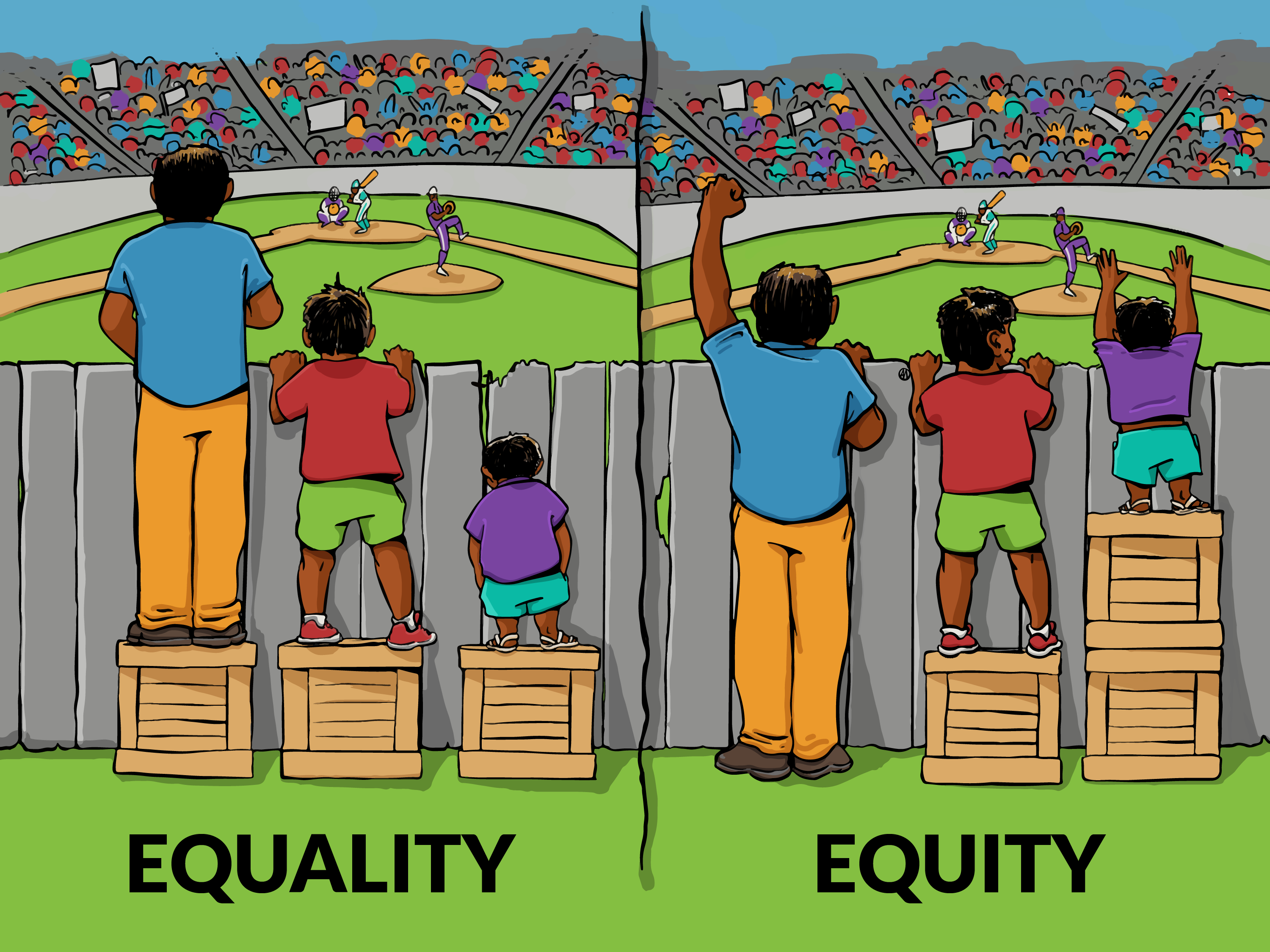
Once that happens, I know my students are ready for the second image:

IISC_EqualityEquity
Source: http://interactioninstitute.org/wp-content/uploads/2016/01/IISC_EqualityEquity.png

This is the first time many students will interact with the word equity, so we discuss it in context of fairness, a word they already know. We discuss the situation students would prefer to be in. I ask whether or not they believe that it is okay for the people on the right to have extra support.

When I then ask students to reflect on where they see this in their personal lives, many of them draw on relationships with their siblings. They talk about times when they weren’t necessarily treated equally (i.e. being responsible for different chores) but they do understand how they were being treated fairly (i.e. everyone had a chore, but you can’t expect the youngest sibling to walk the dog alone).

Students also talk about their school experiences, often using each other as examples. One of my English language learners last year pointed to his best friend and said, “I think Daryl is super lucky because he can use a translator for the test but I’m really the one with an advantage because my English ability is better than his. If Daryl didn’t have the translator, the test wouldn’t actually show what he knows about the topic. It would just be another language test.”

That’s precisely the point.

Students are very, very practiced at seeing the differences between themselves and their peers. They miss relatively little. Giving students the words to talk about what they’re seeing allows them to understand why there are differences in the ways teachers approach different members of the class. It also helps them understand the purpose and necessity of government policies that provide aid to certain groups of people in a variety of contexts.

Addressing Opposing Arguments

I have always had students who argue that giving each student in the room the same test is the only way to truly be objective and unbiased in finding out who knows the most. (In case you were unsure, I am against everything that resembles a traditional sit-silently-and-race-the-clock model of filling in bubbles to find out what students know.)

Since I work really hard to cultivate students’ individual voices in the classroom, I can usually rely on other students to challenge this position and provide evidence that helps the rest of the class develop more nuanced understandings of fair and equal. Depending on the age level of the students and the political bent of the school (unfortunately, this is actually important to be aware of) I may choose to segue this discussion into politics and economic policies, specifically addressing facts and myths surrounding public assistance.

However, in school environments where educators’ academic freedom is more limited or with younger students, it is generally more productive to pose a version of the following question: How can we find out what students know in ways that are fair rather than equal?

I have found that reframing the conversation around fairness, rather than letting students get hung up on their understanding of objectivity, is the more useful discussion. It challenges students to focus on what different individuals need to be successful, while also providing them with an opportunity to talk about formative and summative assessments that think best allow them to demonstrate their knowledge.

Why It Matters

Each student brings a unique background, perspective, set of circumstances, hopes, dreams, and experiences to the classroom. Assuming that an individual student needs exactly what his or her classmates need is harmful not only to the student, but to the rest of the class, as well. Some students need breakfast before we can expect them to learn, while others need additional learning activities to reinforce what they did in class that day. Still others need more difficult questions to consider that help them understand information in a more complex way.

Considering all of these student needs and coming up with one set of activities, one set of questions, one homework assignment, and one assessment might mean that we are treating all students equally.

But in doing so, we would not be treating them fairly.

I am not saying that we need a different lesson plan for every student. What I am saying is that we need to carefully consider what our students need to be successful, and we need to adjust accordingly. We need to take into account who our students are and where they come from. Ignoring all of this and assuming a tabula rasa model of the mind does a disservice to students’ individuality and diversity.

Conclusion

Differentiation takes time, practice, and collaboration with colleagues. It means preparing multiple modes of exploring and interacting with new ideas and concepts. It also means providing variety or choice in assessment of knowledge and learning.

The more differentiation students see in the classroom, the easier time they will have discussing and exploring the difference between fairness and equality.

I believe this is an important conversation to have with students because it draws on their experiences in and outside of the classroom and will prompt them to look around at their world. Students will begin to see circumstances in which fair does not mean equal and circumstances in which equal is actually harmful.

Encouraging students to question what they see is a key part of working to make the world a better place for all. Change is certainly possible, but not if we don’t point out what needs to change. We need to encourage the questions, help students evaluate solutions, and take into account what differences exist and why. Being open to these discussions is necessary for developing a better, more peaceful world


And speaking of being open to discussion . . . If you’ve had similar conversations with students, I’d love to hear about them. Other ideas on differentiation or fairness in the classroom? Comment below!