Tag Archives: Students

“Just because you’ve got the emotional range of a teaspoon . .. “

Devoted Harry Potter fans should recognize this quote. Admittedly, I had to look up the book (Harry Potter and the Order of the Phoenix), probably because it’s so long that I only read it 7 or 8 times. To summarize, Hermione is berating Harry and Ron for not understanding the very complicated feelings of Harry’s current girlfriend, Cho, whose former boyfriend was murdered by Voldemort.

It popped into my head while I was running today, and I actually started laughing, which should tell you how freaking slow this run was. Remembering Hermione’s “emotional range of a teaspoon” rant led me down a rabbit hole of emotion-related thoughts, and not only because theories of emotions was last week’s topic in DP Psych. At the recommendation of a high school English teacher who later became a colleague, I was 18 when I took the Myers-Briggs and found it to be both accurate and revealing. I’m considering taking it again because I recently heard an NPR podcast about how personality changes over time. Have a look or listen here.

All week I’ve been thinking about the theories of emotion that we study in class. We focused on two, the two-factor theory and the cognitive appraisal theory. In the past, I’ve also taught opponent-process, James-Lange, and Cannon-Bard. (I’ll leave the Googling to you for the last three.)

The two-factor theory states that there is a stimulus (thing that happens), which leads to some kind of physiological arousal (e.g. heart beating faster, palms sweating), which leads to a cognitive labeling of the situation (e.g. “This is amazing and making me happy!”), and concludes with the experience of emotion (e.g. joy). The following is a really useful image:

schachter-singer_two_factor_theory-142f804932851b974aa
Source: http://classconnection.s3.amazonaws.com/859/flashcards/4458859/png/schachter-singer_two_factor_theory-142F804932851B974AA.png

On the other hand, the cognitive appraisal theory suggests that we experience emotions as a result two types of appraisal, primary and secondary. As you are experiencing an event, you make a judgement about it. Then there is physiological arousal and you experience the emotion, simultaneously. Primary appraisal refers to the significance of the situation, which will impact an individual’s response, and secondary appraisal refers to how an individual feels he or she can cope with consequences, again impacting response.

picture_16
Hint: ANS = autonomic nervous system. Source: https://classconnection.s3.amazonaws.com/43/flashcards/428043/png/picture_16.png

While all people experience emotions differently, there are common threads to emotions that people identify as either positive or negative. To introduce this topic in class, I had my students choose a particular emotion, either negative or positive, and describe what the brain and body are doing as they experience this emotion. For example, negative emotions (e.g. stress, fear, anger) elicited responses like: sweaty palms, red face, jittery, jumpy, full of energy, argumentative, yelling, dizzy. My students described positive emotions emotions as being: giggly, affectionate, hugging, childlike, optimistic, free, eager, open. Some overlap, we also some common threads in our groups of examples.

On a personal level, I believe that I feel emotions a lot more intensely than most people. My English teacher identified this after my reaction to a reading of Sylvia Plath’s “Daddy” in class and subsequently suggested the Myers-Briggs. My mum tells stories of my temper tantrums as a kid, some of which I remember. She talks about dragging me up the stairs while I screamed and cried about really nothing, throwing me in the bath to calm me down. I bit a lot of pillows, but my parents only taught me that after noticing bruises on my arms. But I have also woken myself from dreams due to literally laughing out loud. I have done cartwheels down schools hallways (both as a student and as a teacher). I feel the need to hug everyone around me and restrain myself only because that’s not socially acceptable. The first time I was in a serious relationship my heart beat faster than normal for days, I lost my appetite, I couldn’t sit still, I couldn’t sleep. Someone once called the range of emotions I feel simultaneously “exhausting.” It can be.

A lot of people feel really intense emotions, and maybe the above is more normal than I think it is. Regardless, I almost always act on my emotions, positive or negative, and that’s been a problem.

As I’ve gotten older, I’ve learned to act and react more quietly, at least to the eyes and ears of others. I keep myself almost constantly busy when I’m upset to avoid ruminating because I know how riled up I will be if I let myself do that. A small change, for example, was journaling only once I’d calmed down rather than while I was upset. That can take hours. Sometimes it takes days. By the same token, emotions that are already strong like excitement and passion leave me full of jittery energy for days at a time. These days are usually very productive, despite loss of sleep that comes from said nervous energy, because if I’m moving I can stop thinking.

I have found myself muting my emotions when interacting with others. I’m probably feeling a lot more than I admit I’m feeling, whether those emotions are positive or negative. Maybe this comes from social cues about how much people are supposed to feel at once. Maybe those social cues are inaccurate and, like much of what we do, simply a social norm. And maybe others do sense that I’m not disclosing everything I could be. A friend and colleague in Malaysia describes me as guarded and he was right. Additionally, I wonder if my feelings last for longer than those of other people do. I have also found, as I mentioned in yesterday’s post (What?! Two posts in two days?!) that holding in all of those emotions has been a problem. And I do feel better when I let them out. This, I know, is normal.

What I don’t know is which theory of emotion sounds the most plausible to me. My students struggled with this, too. All are supported with empirical evidence, and therefore disputed based on other empirical evidence. Under some circumstances, I expect I act first and think later (e.g. the time the transmission blew on our boat full of passengers and we were floating in the middle of a river and needed someone on the only dock in that entire section of the river to help us with a line – definitely acted first and panicked later) Under others, however, I react based on how I think I’m feeling (e.g. being chased by lots of dogs while running in Malaysia – terror like I’ve never felt and then running faster than I’ve ever run).

If I’m totally off the mark on this, please let me know! Few feelings? Many feelings? No feelings? Feelings with no names? Comments always welcome.
 

Please Hire Me.

It’s time I made this public: I’m moving again.

Yup, again. I love Singapore and I love my school. I love my friends here and I love the travel I’ve been doing throughout my time in Southeast Asia. More importantly, I love my department and I love the curriculum we’re developing. I am actually excited to develop this curriculum, which is something I never thought I’d say. We’ve made the decision (and been given permission) to completely redesign the MYP Individuals and Societies courses at school and we’re doing it through a lens of sustainable development with a focus on scientifically and morally based problem solving. And it’s really going to happen, which is the coolest part. I so wish I could be here to teach the ninth and tenth grade iterations of this curriculum next year. That would be such a wonderful experience, and I am so excited for all of my colleagues and for all of the students who are going to part of it. I would love to join them.

But I also love a really wonderful man and he’s in New York City. Because of his job, Mitch is likely to be in New York City for a very long time. Our rough estimate is a decade at the minimum before we can even entertain the thought of going elsewhere. For better or for worse, going through the rest of my life without Mitch isn’t an option I’m willing to consider, awesome curriculum or not.

So it’s time to go back.

I made this decision a few months ago and took the necessary HR steps back in December. Most of my colleagues know that I’m leaving, but I haven’t said anything to my students. I have a lot of unfinished business as far as they’re concerned (this curriculum, only developing the first of two years of DP Psych) and I’m not entirely comfortable letting go. I have no doubt that whoever takes my place will be more than qualified. I have no doubt that my very capable colleagues will do brilliant work with the curriculum and really change what we’re teaching and how we’re doing it. And there’s really no reason I can’t continue that reevaluation in my own classroom, wherever it happens to be.

I’ve been looking for jobs for over a month, which I know is not a very long time. I’ve applied to a lot of wonderful schools and even more less wonderful schools. I’m waiting to hear about my application to the NYC public school system. I’m waiting to hear from nearly everywhere I’ve applied. There’s only been one flat-out “no”, but I honestly prefer that to silence. It’s a competitive market, so I’m trying not to be too picky. I’m also trying to find a school that will let me teach and let me do it well.

One day, I’ll find myself back in a progressive school in which I’m allowed to teach what should be taught, not what has always been taught. That’s been the best part about teaching the MYP this year, and it’s only going to get better. We have so much freedom to do what’s right as long as we’re working towards the IB aims of responsible action and creating a peaceful world. And who doesn’t want to do that?

At the moment, I’m not ready for my time in Singapore or overseas to be over. I never really planned on reaching that point, but I haven’t planned on a lot of things. So here’s to the next five months – to making them count.

Travel Guide: Battambang

This week-long adventure was different from any I have ever experienced. This was my first time in Cambodia and my first traveling internationally with students. I visited Battambang with the entire grade 10 class of my school (about 90 students) along with the seven other teachers. Upon arrival, we joined JUMP!, a very wonderful experiential education social enterprise with which school is currently working to plan the annual field studies trips for all secondary school students. I am in awe of what JUMP! planned and how their plans came to fruition.

But I’m getting ahead of myself.

The focus of the grade 10 week in Battambang, Cambodia’s second largest city, was to get students thinking about community development, both as communities of advisories (groups of about 15 students that meet daily) and global communities. We spent the week learning from and working with different social enterprises that aim to make Cambodia a better place. All the restaurants where we ate were social enterprises, as well. As part of the program, we explored privilege, voluntourism, sustainable development, Cambodia’s history, and how to bring about positive social change. Throughout the week, I saw my students’ hearts and minds open up, not only to these ideas but also to each other as individuals and as friends. I can say without a doubt that every student returned to Singapore wiser, humbled, empowered, and with new friends.

This post will chronicle my week in Battambang as best as I can based on the photos that I can share. Most of my photos for the week were of and with students, and there are a variety of reasons (i.e. privacy, confidentiality, just plain propriety) why I won’t share them in an unprotected online space. Heartfelt thanks both to JUMP! for their incredible work and to John, the extraordinary JUMP! facilitator assigned to my advisory for the week.

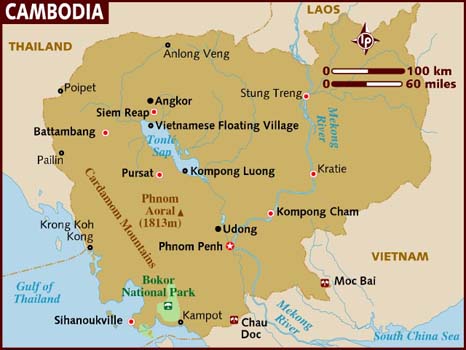
To get oriented, here is a very helpful map from Lonely Planet:

map_of_cambodia
We flew into Siem Reap on Saturday and drove the 3+ hours to Battambang the next morning

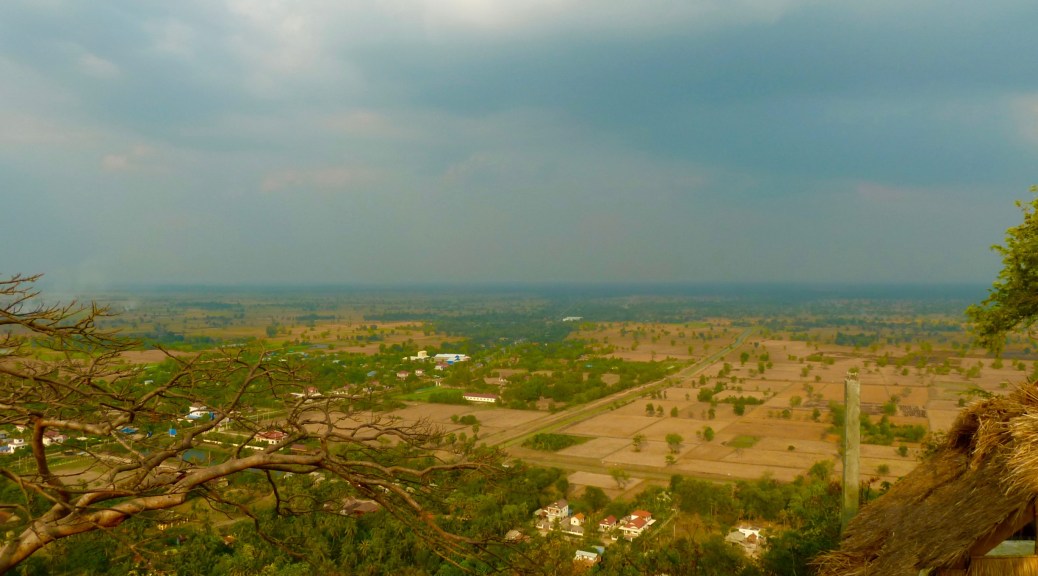
One of our first activities was a tuk tuk ride to visit Phnom Sampow. We took a difficult climb up a steep hill, pausing along the  way to see Buddhist temples and learn about Cambodian agriculture from our guide. We could see farms for miles from various lookout points.


The temples were exquisite, as well. I have a few Buddhist students who stopped to pray along the way.


We also encountered a number of monkeys and actually had to alter our route at one point to get away from them. Monkeys are vicious and will grab any food item or even backpack in site. My favorite monkey was this one:

P1060457

The highlight of this trip, though not photographed because I felt weird about that, was the killing caves, a site of Khmer Rouge slaughter. The caves contained a memorial to victims, including skulls of those who died there and a Buddha statue for those who wished to pay respects.

Probably my favorite morning of the trip started with a trip to a local market to pick up ingredients for the Cambodian lunch we would learn to prepare! The market was wonderful (and sold more than vegetables, though my photos might have you believe otherwise) and the cooking school was incredibly accommodating to my vegetarian needs. Even better: We received cookbooks to take home!


Another really transformative experience was our visit to COMPED, a social enterprise that collects organic material, turns it into compost, sells it to farmers for fertilizer, and uses the money to run enrichment programs for children. To learn about what they do, we visited a market, collected rotten produce, and shoveled it onto the compost pile at a local dump. While there, we also learned that the families who live on the dump are paid more than they would be in other jobs. Despite health risks from being around burning trash, they choose this life to feed their children.


Another social enterprise, Coconut Water Foundation, also runs after school and summer enrichment programs for students. We joined them at a school for about an hour one morning to play games with some of the students. Rather than sharing pictures of children, here are a few artsy shots:

P1060710

P1060718

Our last full day found my group on a bike ride with Soksabike, a social enterprise that pays families to produce traditional products, therefore putting money into the economy, and brings tourists to see these products. Soksabike’s tour guides are local university students who are working to enhance their English skills as they do their jobs.

Among other things, we learned how rice paper is made . . .

P1060772

. . . and sampled some delicious dried and fried bananas.

P1060777

The final stop on the tour was a very moving memorial to another killing fields site across the street from a Buddhist temple that the Khmer Rouge turned into a prison and interrogation facility. I didn’t have the heart to take pictures of the memorial, mostly because it broke my heart. The 1970s weren’t that long ago, and the Khmer Rouge existed in Battambang until 1991. 25 years ago is not very many years. The detachment with which Cambodians speak about the Khmer Rouge genocide is painful to witness.

I don’t have photos to share, but other social enterprises that we visited and worked with were Phare, FEDA, and Cambodian Children’s Trust. All of these organizations work with and for community development, specifically targeted at children. CCT was the most moving for me because they taught us about orphanages and orphanage tourism. We learned that 80% of children in Cambodian orphanages have living family and are in orphanages (and often exploited and abused as a result) because their families were tricked into thinking their children would have better lives and a better chance at education.

It was a week of growth, that’s for sure. I’ll be back in Cambodia in March to spend a weekend in Siem Reap to visit Angkor Wat. I’m so grateful for the opportunity to travel with my students to Battambang to learn how real Cambodians live. The trip we took and experiences we had would not have been possible for me to orchestrate. JUMP!, thank you for opening my eyes to this beautiful country and its proud, hopeful citizens.

P1060627
At the old abandoned airport one night