
Tag Archives: Students

Before the First Day of School

I don’t know how other jobs work. When you start a new job, do you have time to ease in? Are there people around who can set aside their own tasks to walk you through things you don’t know? Are you joining a team with a defined role, or are you a new member of a group defining your own role?

I don’t know how other jobs work.

I just know that every time a new teaching job begins, it’s like starting from the first day all over again. “How are you doing?” people keep asking me. This will be my eleventh year teaching and the best I can say is, “I’m doing.” The sympathetic nods and kind smiles I receive in response indicate that my state of managed overwhelm is not unexpected.

Perhaps teaching is unique in the sense that you have a finite amount of time to prepare for everything, after which everything you do will have an impact on the life of a young person. I don’t mean to make myself sound more important than I am; after all, many, many things impact all of us every day and I possess no powers of divination with which to determine what is or is not ultimately relevant. Rather, it seems that the need to be good at your job has different stakes.

But again, I don’t know how other jobs work.

I do know that it always feels like this upon joining a new school. And to some degree, at the start of a new school year. In which other jobs does the entire staff use a week to prepare before beginning? It’s a bit like the performing arts, actually. Everything needs to be ready before day one and then, despite even years of rehearsal, so much seems to come down to improv – what do these particular young people need on this particular day? Making that series of decisions at the very moment they arise is both an art form and a science, one that is honed over time, and one that fades into the background when we prepare in the abstract.

Our students start on Wednesday and it feels a bit like I’m missing the forest for the trees. Much of what I’m preparing right now might be irrelevant once I meet them, yet I can’t meet them without having done this preparation. My agonizing about the loss of a piece of technology that has been at the centre of half my teaching career, while requiring me to rethink, reframe, and readjust, might very well have no impact on these students at all. I am spending my time trying to figure out new unit planners, new locations for resources, new policies, and new classroom arrangements, all of which are invisible when the students arrive but which lay the groundwork for the system to run.

And when the students arrive, I remember how it feels to educate, to learn, to inquire, to build community with young people. I remember that I’m not only competent at my job but good at it, and that every day with students brings me more joy than any school day without them.

I don’t know how other jobs work.

I don’t know if other people wake up in the middle of the night with visions of how to redo something they’ve already considered done. I don’t know the questions people in other jobs ask themselves.

In my 100 hours with these students this year, what kind of person do I want to help them become?

We need the prep work and time because we need a solid foundation. These are people we are shaping. Of course, we educators are just a small part of raising these young people; there are a plethora of other factors over which we have no control. But we have a wonderful opportunity to do some good and all young people deserve that.

Commencement: A Beginning

This year, I had the greatest honour I have ever had.

Our class of 2021 voted for me as their graduation speaker which, as one of my colleagues put it, is about as good as it gets for a teacher. Students were on campus for graduation and families attended from home via livestream.

These were my words to our students, and to students everywhere:

It is a true honour to speak to you today, and I thank you from all of my heart. The best way to describe my feelings upon hearing about this is the Yiddish word verklempt, which roughly means full of emotion and speechless. I felt this way because I was deeply touched and I had no idea what to say. Just because I think a lot of things doesn’t mean I know a lot things. But I have lived a lot and this has led me to some understandings. In the next few minutes, I will do my best to share them with you.

Over the past two years, I have watched this class grow in many ways, the most significant of which, the one that I think best defines this class, is how you have grown in your resilience. To be resilient means to bounce back, to respond to adversity, to rise up stronger and wiser than you were before. You did this, and continue to do this, in rather complicated circumstances while managing your studies, maintaining hobbies and activities, and making plans for the future. You rose to this challenge. And now, you are here. This is resilience.

The ability to be resilient, to see challenges as opportunities to grow, is something to carry with you always, regardless of what happens next week, next month, or five years from now. And as we all continue to learn, we cannot rely on well-laid plans, but plans are required if we hope to move forward. Resilience is the story of the class of 2021; what will be the story of your individual life?

A few years ago I discovered rock climbing, and it has become a significant part of my world. My favourite of the climbing gym’s motivational posters says: Ask yourself if what you are doing today is getting you closer to where you want to be tomorrow. Only you have the power to live your life. All actions have consequences, and your decisions will set you on different roads that allow for different possibilities. I have learned that these decisions affirm who we are, and also lay the foundation for who we will become. And even though you might wish otherwise, you will never know where the other road might have taken you, and you will never know who you might have been had you taken it.

So this is a critical question: What kind of person do you want to be as you begin your next chapter? Educator John Holt wrote, “The true test of character is not how much we know how to do, but how we behave when we don’t know what to do.” Your character guides how you respond to your environment and those around you, and it is your character that exemplifies the values that are central to how you understand yourself and others. When we are confident and comfortable, surrounded by family and friends, we know who we are. Here, at Southeast Asian International School*, you know who you are. You know who is there for you, what is expected of you, and how to behave.

But things are about to change. Graduation marks the end of this chapter and the beginning of a new journey. You will have beautiful, remarkable, memorable moments. But there will also be times when you stumble. When you fail. When you are caught unawares, uncertain, or having made a terrible mistake. But you have proven yourself to be resilient, and this means that you will stand up and you will begin again. And if you are courageous enough, you will find yourself with choices.

Ask yourself if what you are doing today is getting you closer to where you want to be tomorrow. Sometimes, the way forward is obvious and you clearly know what is the right thing to do. But sometimes, actually doing the right thing is very hard. This is when you need to ask yourself about the person you are becoming and what matters to you. You can decide how to act, who to be around, and how to build the community you want to live in. And you can change your mind when the road you are on is not right.

To send you on your journey, I would like to offer my deepest hope for you: That you find a path with a heart. This idea comes from The Teachings of Don Juan by Carlos Castaneda, which is somewhere between anthropology and memoir. Don Juan explains that a path with a heart can go anywhere or nowhere – how it goes is what matters. As I understand it, when a path has a heart, it is right. It is the deep conviction that we experience without the need for words. This is the path that gives us joy, strength, and a sense of peace.

And finding this path takes work, perhaps trying multiple paths before reaching the right one. You will know that you are on your path when it speaks to who you are, how you understand the world and your place in it. Sometimes, you can keep going with what you have already begun. But sometimes, the scariest and most important thing to do is stop and start again. The choices that we make, and the character that reflects our values and guides our behaviour, allow us to walk a path with a heart. Doing this takes resilience, it takes courage, and it can take us to places we’ve never dared to imagine.

As poet Mary Ann Evans, better known by the pen name George Eliot, wrote, “It is never too late to be what you might have been.”

Travel the path with a heart. The path is a journey. The journey is life.

Congratulations, Class of 2021. I can’t wait to see who you become.

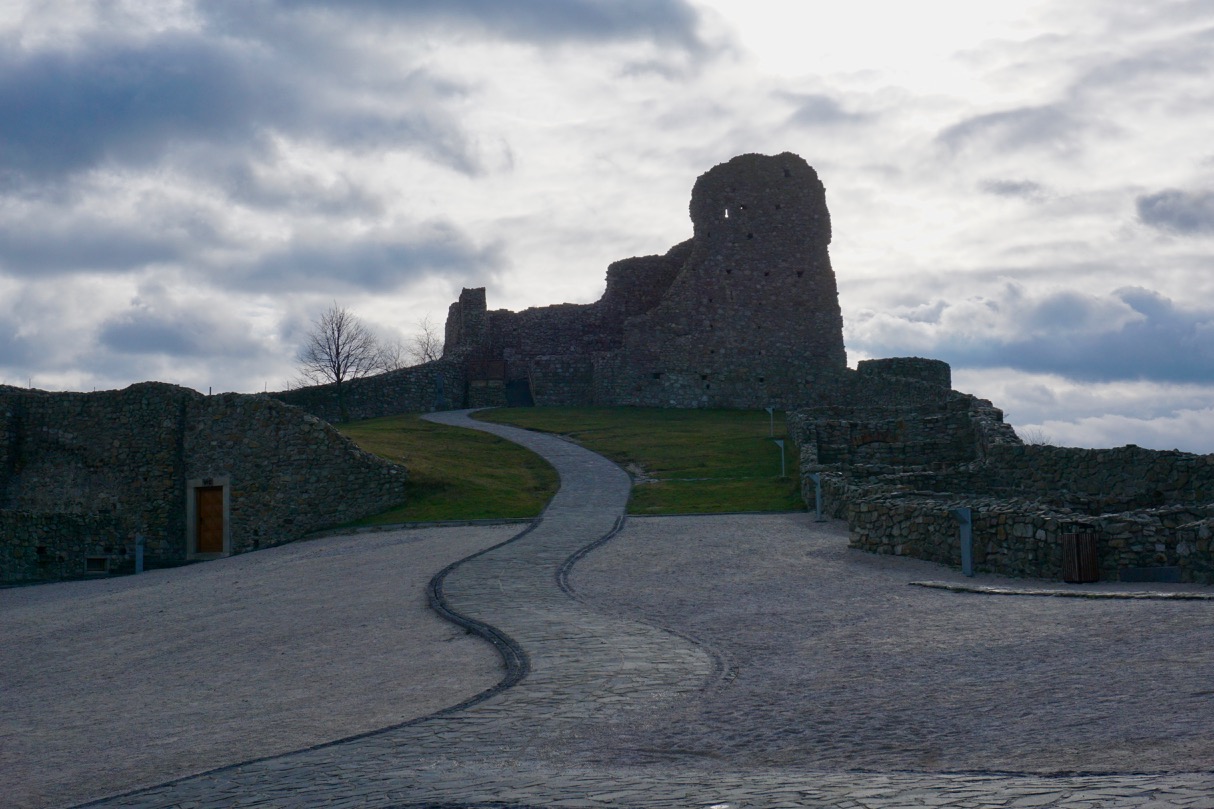
The road to Devín Castle – Bratislava, Slovakia – January 2019

*Name changed to protect the innocent, as a friend and former colleague would say

Put Together

“Miss, at what age did you feel that you had your life together?”

I had to smile and it’s a good thing I was wearing a mask. I have been asked this question over and over since I started teaching at the tender age of 21. At that time I felt as though I knew nothing about anything, and some days that was true. Now, I like occupying the space between young enough to be relatable and old enough to be wise.

My answer has always been the same internally – What? Me? Put together? – but I’ve gotten better at articulating a message. It’s important to appreciate the intent behind such a question, which is not to find out about my life. Rather, these students want to know how to manage their own lives. They are uncertain and want to know that there is hope for a time when they will not feel uncertain.

I’ve been given the honour of speaking at graduation and I think the speech will include a part about the uncertainty of one’s life path. But when I was talking to this student yesterday, I answered her question in way that actually got me thinking and perhaps there’s something to that.

Context is important here. The student who asked me this question has been in my Advisory for the past two years, and while I haven’t taught her in a class, I am privy to her difficulties managing time, getting along with teachers, and living away from parents. I know that she has had a hard time; she was the happiest I’ve seen her when she spent our online learning period in her home country. The other two students in the room were also not students I have taught, but who I know a little bit about. They were listening as I answered, especially the quiet young man in the back of the room who even raised his face from his laptop for a moment. I looked over at him and he knew I knew.

“Miss, at what age did you feel that you had your life together?”

“Well, I guess the question is what it means to be together. We only see what people show us externally, right? We don’t know what’s going on inside. And I think a lot of the time we put on an external face but inside, we’re in pieces.”

“But how are you able to do that?”

“To appear like everything’s fine?”

“Mhm.”

“I think that’s something we learn to do. We all have coping mechanisms, right? You know when you’re having a bad day but I might not. And sometimes you just put that bad day in your pocket and go about your business until you get home and then you can fall apart. But I think we forget that other people are doing the same thing because we don’t see them like that. We only see what they show us, so that’s all we know of them.”

“Hm.”

Perhaps not the answer the student was hoping for, but the most honest one that I have. This is a student who is obviously struggling and doesn’t see, when she looks at everyone around her, that she’s not the only one. And so she feels alone. I know this because we have talked about it.

For me, this raises a few questions about cultural context and about social media. My school is highly westernized, a pervasive problem among international schools. (Danau Tanu’s book Growing Up in Transit is a stunning exploration of this and it led several colleagues and me to a crisis of being earlier this year.) The way a student might have been enculturated to respond to problems, then, quite possibly does not match the dominate narrative of our school, which leads to further confusion. Additionally, social media is highly westernized, and social media in American English presents a dominant narrative of what “okay” and “not okay” look like. (I am indebted to Lisa Feldmen Barrett’s How Emotions Are Made, which I’ve mentioned before. I cannot recommend this book enough.)

Putting this together, it is no wonder that this student is struggling to cope. She belongs to a culture that has a different mental health narrative than the educational climate and social media context in which she spends her time. This might seem a bit abstract, but I think this problem is clear in a very concrete way in social media narratives. Overwhelmingly, social media does not portray people who are not okay. We’re supposed to be happy. And we’re supposed to post photos demonstrating that we are happy. And we’re supposed to “like” or “love” or “react” to other people, whether we know them or not, to reinforce how happy we are that they are happy.

This is clearly not healthy. And so I have more questions. What was the world like before social media took over? Were people more open with each other? More honest? Did young people have a more realistic sense of what real life was like? Were young people actually in the world instead of hidden and sheltered from it?

I suspect that in some ways, questions like these have always been asked across generations. And young people have always grown into functioning adults. I just hope that the conversations we have with them, and the way we treat their concerns, help them grow in ways that are adaptive rather than giving them a false sense about what it really means to put our lives together. (Hint: There is no celebratory medal announcing that we’ve got it right.)

So when I did I have my life together? I’m not sure what “together” looks like. But I know I am living my life and that, in and of itself, is enough.

For a long time it seemed to me that life was about to begin – real life. But there was always some obstacle in the way, something to be gotten through first, some unfinished business, time still to be served, a debt to be paid. At last it dawned on me that these obstacles were my life. . . . So treasure every moment you have and remember that time waits for no one. – Alfred D’Souza

Maribor, Slovenia – January 2020