Tag Archives: Students

Put Together

“Miss, at what age did you feel that you had your life together?”

I had to smile and it’s a good thing I was wearing a mask. I have been asked this question over and over since I started teaching at the tender age of 21. At that time I felt as though I knew nothing about anything, and some days that was true. Now, I like occupying the space between young enough to be relatable and old enough to be wise.

My answer has always been the same internally – What? Me? Put together? – but I’ve gotten better at articulating a message. It’s important to appreciate the intent behind such a question, which is not to find out about my life. Rather, these students want to know how to manage their own lives. They are uncertain and want to know that there is hope for a time when they will not feel uncertain.

I’ve been given the honour of speaking at graduation and I think the speech will include a part about the uncertainty of one’s life path. But when I was talking to this student yesterday, I answered her question in way that actually got me thinking and perhaps there’s something to that.

Context is important here. The student who asked me this question has been in my Advisory for the past two years, and while I haven’t taught her in a class, I am privy to her difficulties managing time, getting along with teachers, and living away from parents. I know that she has had a hard time; she was the happiest I’ve seen her when she spent our online learning period in her home country. The other two students in the room were also not students I have taught, but who I know a little bit about. They were listening as I answered, especially the quiet young man in the back of the room who even raised his face from his laptop for a moment. I looked over at him and he knew I knew.

“Miss, at what age did you feel that you had your life together?”

“Well, I guess the question is what it means to be together. We only see what people show us externally, right? We don’t know what’s going on inside. And I think a lot of the time we put on an external face but inside, we’re in pieces.”

“But how are you able to do that?”

“To appear like everything’s fine?”

“Mhm.”

“I think that’s something we learn to do. We all have coping mechanisms, right? You know when you’re having a bad day but I might not. And sometimes you just put that bad day in your pocket and go about your business until you get home and then you can fall apart. But I think we forget that other people are doing the same thing because we don’t see them like that. We only see what they show us, so that’s all we know of them.”

“Hm.”

Perhaps not the answer the student was hoping for, but the most honest one that I have. This is a student who is obviously struggling and doesn’t see, when she looks at everyone around her, that she’s not the only one. And so she feels alone. I know this because we have talked about it.

For me, this raises a few questions about cultural context and about social media. My school is highly westernized, a pervasive problem among international schools. (Danau Tanu’s book Growing Up in Transit is a stunning exploration of this and it led several colleagues and me to a crisis of being earlier this year.) The way a student might have been enculturated to respond to problems, then, quite possibly does not match the dominate narrative of our school, which leads to further confusion. Additionally, social media is highly westernized, and social media in American English presents a dominant narrative of what “okay” and “not okay” look like. (I am indebted to Lisa Feldmen Barrett’s How Emotions Are Made, which I’ve mentioned before. I cannot recommend this book enough.)

Putting this together, it is no wonder that this student is struggling to cope. She belongs to a culture that has a different mental health narrative than the educational climate and social media context in which she spends her time. This might seem a bit abstract, but I think this problem is clear in a very concrete way in social media narratives. Overwhelmingly, social media does not portray people who are not okay. We’re supposed to be happy. And we’re supposed to post photos demonstrating that we are happy. And we’re supposed to “like” or “love” or “react” to other people, whether we know them or not, to reinforce how happy we are that they are happy.

This is clearly not healthy. And so I have more questions. What was the world like before social media took over? Were people more open with each other? More honest? Did young people have a more realistic sense of what real life was like? Were young people actually in the world instead of hidden and sheltered from it?

I suspect that in some ways, questions like these have always been asked across generations. And young people have always grown into functioning adults. I just hope that the conversations we have with them, and the way we treat their concerns, help them grow in ways that are adaptive rather than giving them a false sense about what it really means to put our lives together. (Hint: There is no celebratory medal announcing that we’ve got it right.)

So when I did I have my life together? I’m not sure what “together” looks like. But I know I am living my life and that, in and of itself, is enough.

For a long time it seemed to me that life was about to begin – real life. But there was always some obstacle in the way, something to be gotten through first, some unfinished business, time still to be served, a debt to be paid. At last it dawned on me that these obstacles were my life. . . . So treasure every moment you have and remember that time waits for no one. – Alfred D’Souza

Maribor, Slovenia – January 2020

Becoming

There’s a poster in the bathroom at the climbing gym that says: Ask yourself if what you are doing today is getting you closer to where you want to be tomorrow.

I really like this. I am moved by it every time I see it, and I have seen it many times. It has pushed me to be a better climber: Do the pull-ups, go through the routine on the hangboard, take the lead fall. It has pushed me to stop running, climb more frequently, and dedicate an afternoon a week to core training. When I started climbing a few years ago, I knew I’d found something special, something that I really loved the way I hadn’t loved anything since I moved away from snow and left my skis behind. I want to be good at it and I have been working to make that happen.

The climbing gym has other inspirational posters (Sometimes stillness is harder than movement and Climbing is like dancing on the wall) that never fail to catch my attention but this is the one that speaks to me the most.

Ask yourself if what you are doing today is getting you closer to where you want to be tomorrow. Just last week I wrote this on the board for my grade 12 students. They are currently sitting their mock exams in preparation for their real AP and IBDP exams in May. Most students’ university acceptances depend on these exams and they are learning right now how prepared they are. So, this is a pivotal time. This is an opportunity for students to gain confidence in what they know and make adjustments to habits and patterns in response to what they don’t know. Are you, right now, doing what is required to get you where you want to be? There is force and agency behind this question, as well as the explicit onus of responsibility.

But there is a significance far beyond grades and university acceptances. There is the cold, hard fact that all of our actions have consequences. The choices we make, and we are constantly making choices, set us on certain paths and allow for different possibilities. This not only affirms who we are, whether or not that is who we want to be, but also lays the foundation for who we will become.

I’ve been thinking back lately to the understanding I had of myself and those around me when I was younger. Over time, I have met people who I look up to, admire, and still aspire to be like, years later. But I have also met people who have had quite the opposite affect. The memories of the words and actions of these people still send anger coursing through my body. Years and years later.

Part of our understanding of where we want to be, therefore, should come with an awareness of who we want to be around. We want to be around people who will lift us up rather than tear us down, people who will answer the phone far too late just because we called when it was far too late. We want to be around people who challenge us in constructive rather than destructive ways, people who give us room to grow. If we are lucky, we will also surround ourselves with people whose trust goes unquestioned, people who have already forgiven our trespasses. And when we find people like this, we should hope that we will know better than to let them go.

Where we are thus encompasses who we are, and who we are helps us make choices about where we want to be. I could not be planning yet another move alone to yet another country had I not made the choice to be the person who makes the most sense to me. And this choice has not come easily, which is also how I know it is right. The life I am living is a life I never could have imagined and I would have laughed at anyone who told me three, six, or ten years ago that this would be my world. Thinking back to what I thought I wanted, and thinking ahead to what I dream about, is sometimes a masochistic exercise fuelled by hard liquor and late nights. But this is the driver of change. Ask yourself if what you are doing today is getting you closer to where you want to be tomorrow.

And according to an artist whose work I bought many years ago when it brought me to tears: If you want something you have never had, you must do something you have never done.

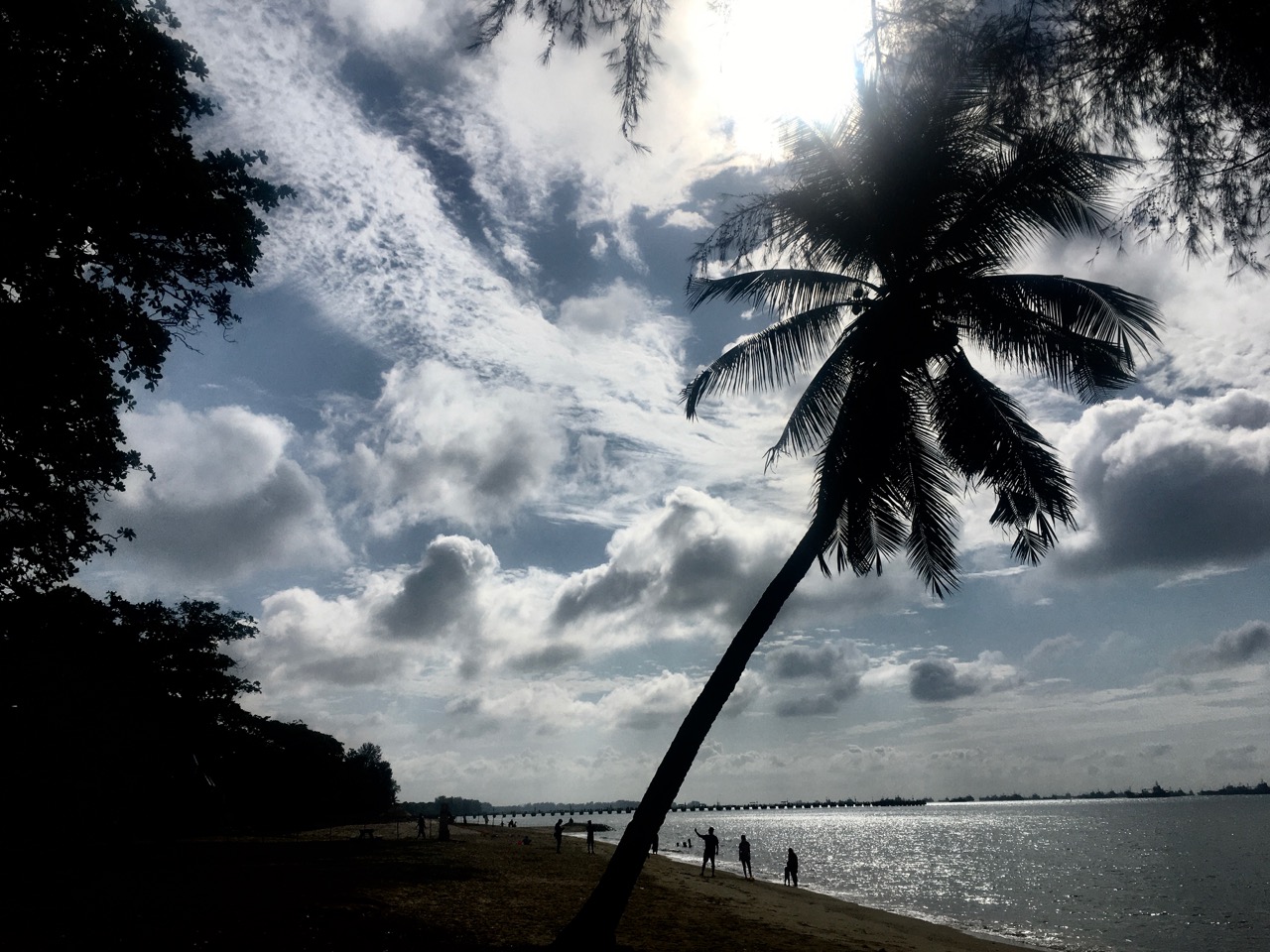
East Coast Park, Singapore – March 2021

Talking with Young People

Educating is about building relationships and this is what makes it emotionally demanding. Our students need us to be present, to be with them, to recognise and name what they either cannot or will not name. When I say that I work with young people, I mean that we work together, side by side. We go through concepts, ideas, information, and assessments together. We are often not doing the same thing, but we do it together.

One of the textbooks assigned in my education methods courses as an undergrad was Discipline with Dignity by Curwin, Mendler, and Mendler. It spoke of respect, responsibility, of treating young people first and foremost as people. This sounds funny to say, but think about it. Educators have a lot of power and that power can build a child up or totally, utterly cut them down.

In the words of Haim Ginott, words that still give me chills:

“I’ve come to a frightening conclusion that I am the decisive element in the classroom. It’s my personal approach that creates the climate. It’s my daily mood that makes the weather. As a teacher, I possess a tremendous power to make a child’s life miserable or joyous. I can be a tool of torture or an instrument of inspiration. I can humiliate or heal. In all situations, it is my response that decides whether a crisis will be escalated or de-escalated and a child humanised or dehumanised.”

And this means that teachers must recognise the human role they play in the classroom. We are all beings with dignity and honouring this is critical in the way we treat others – who they are, what matters to them, and the demands we place on their time and energy. Throughout my career, students have come to me just to talk. I’ve heard, “You’re the only one I trust” more times than I can count. I’ve been thanked for saving lives years after the fact. How hard is it, really, to treat a young person the way all people should be treated?

But it is hard. All meaningful relationships are hard. Doing this requires vulnerability and courage. It requires understanding that we are in this together and this can be a difficult position for teachers who do not understand that educating is about relationships. Students know when we are authentic and they know when we are disingenuous. Like all of us, they respond to what is genuine and protect themselves from what is false. I want my students to be good people and this requires me to walk beside them.

At the beginning of this school year, I finally had the chance to get to know a group of young men who had made cafeteria duty a miserable experience the two years before. I smiled while greeting them and said to the class, “To those of you who I have encountered, this is a great opportunity to prove that you’ve grown up.” And they have. Each interaction that we have with young people is a new interaction. Each day really is a new day. If we are going to work together for a year or two, we need to set ourselves up for doing so. I’ve learned to take a deep breath each time I address a question or comment from a student who just grates on me. He deserves the same chances, the same positive attention, as anyone else, time after time. This is how we learn, and I want my students to leave my class knowing more about themselves and the world around them than they did before.

When we feel valued for who we are, we respond. We know this as adults and it is ever more true of young people. A smile, making eye contact, tone of voice, and gestures are all part of communication. Just like how we might know how someone feels about us without them saying so, students know this, too. We like to know someone is looking out for us. This is why teachers should pay attention when a student gets new shoes, a haircut, or looks like they’re having a tough day. It’s a powerful thing to close the laptop and look young people in the eye when having a conversation, or to sit on the same side of the desk that might otherwise act as a barrier. When we sit side-by-side, we are working together. Each member of the classroom community matters, so take the time to do the small things that set a tone.

These are emotional investments that make what we do real rather than abstract. Educating is about building relationships. It is work. It is time intensive, meaningful, deeply fulfilling, and it has the power to change lives. Young people are worth it.

Coney Island, Singapore – April 2020