Category Archives: Education

Fair Is Not Equal

My new teacher orientation finally starts on Thursday. I’m teaching grades 6 and 8, which are both new to me. Teaching, however, is not new. This will be my sixth year as a teacher and each year has gone faster than its predecessor. By the end of this year, I will have taught every grade that my 5-12 social studies certification allows and I’m pretty excited about that.

I wanted to put together a short post on the difference between fairness and equality. The ideas reflected here are also found elsewhere on my blog, but I hope to clarify why I find this distinction so important in the classroom. Many of my personal beliefs on this topic stem from my Master’s program in inclusive education and my experiences teaching at two international schools where students speak literally dozens of languages.

What follows is an explanation of the difference between fairness and equality, how I encourage student discussion on the topic, and why I feel differentiation and conversation about it are necessary.

Background

We spend a lot of time discussing fairness with young children. We teach them about taking turns, about sharing, and about making sure each child has the same number of cookies. We might call it fairness, but we are actually promoting equality, which is not the same thing. Equality means treating everyone the same way. It means providing each child with the same number of turns on the swings, the same number of carrots, and the same choices between which two books to read.

As children grow older, they begin to realize that they are not treated the same way as their siblings or classmates. They cry out, “That’s not fair!” when parents  or teachers treat different children differently. (In my parents’ house, my dad’s stock response was, “Tough” while my mum preferred a calmer but equally devastating, “Life’s not fair”.)

What children mean is that what they are seeing is not equal. It is likely, however, completely fair.

From an educational perspective, fairness means providing each student with what he or she needs in order to be successful. Different students need different supports to achieve a desired outcome. As parents and teachers know, fairness means approaching each child differently based on different needs. Treating everyone equally, as though the are the same, is counterproductive to the goal of success.

Discussing Fairness in the Classroom

I like to discuss the difference between fairness and equality with my students. It leads to really interesting discussions about students’ individual needs, backgrounds, experiences, and goals. Most importantly, openly discussing fairness helps students realize the danger of assuming that a single way of helping others will work for everyone who needs help. It also helps them understand why so many people struggle in so many different ways.

Generally, I start the discussion of fairness and equality by showing students one of my favorite educational cartoons and asking for initial reactions:

6a00e54f8c25c98834017c317442ea970b-500wi
Source: http://scholasticadministrator.typepad.com/.a/6a00e54f8c25c98834017c317442ea970b-500wi

The cartoon usually gets a laugh and responses like, “That’s stupid” and “Fish can’t climb trees” and “Obviously the monkey will win”.

This, I assure my students, is precisely the point. The next question I ask is whether they have had this experience in their own lives, particularly in school.

Students are usually quiet for a few moments. Inevitably, one student will volunteer to share a time when he or she was unprepared for a test because of switching schools, missing class time, difficulty understanding material, language barriers, struggles at home, etc. Once one student begins to talk, the rest of the class draws similar conclusions. (Pedagogical note: I am a huge fan of think-pair-share activities during discussion.)

This image above acts as our example of equality for the discussion that follows. All the animals in the image are being treated equally, by simple fact of definition. They are being treated the same way.

I can usually count on a student to point out, “Yeah, but that’s not fair.”

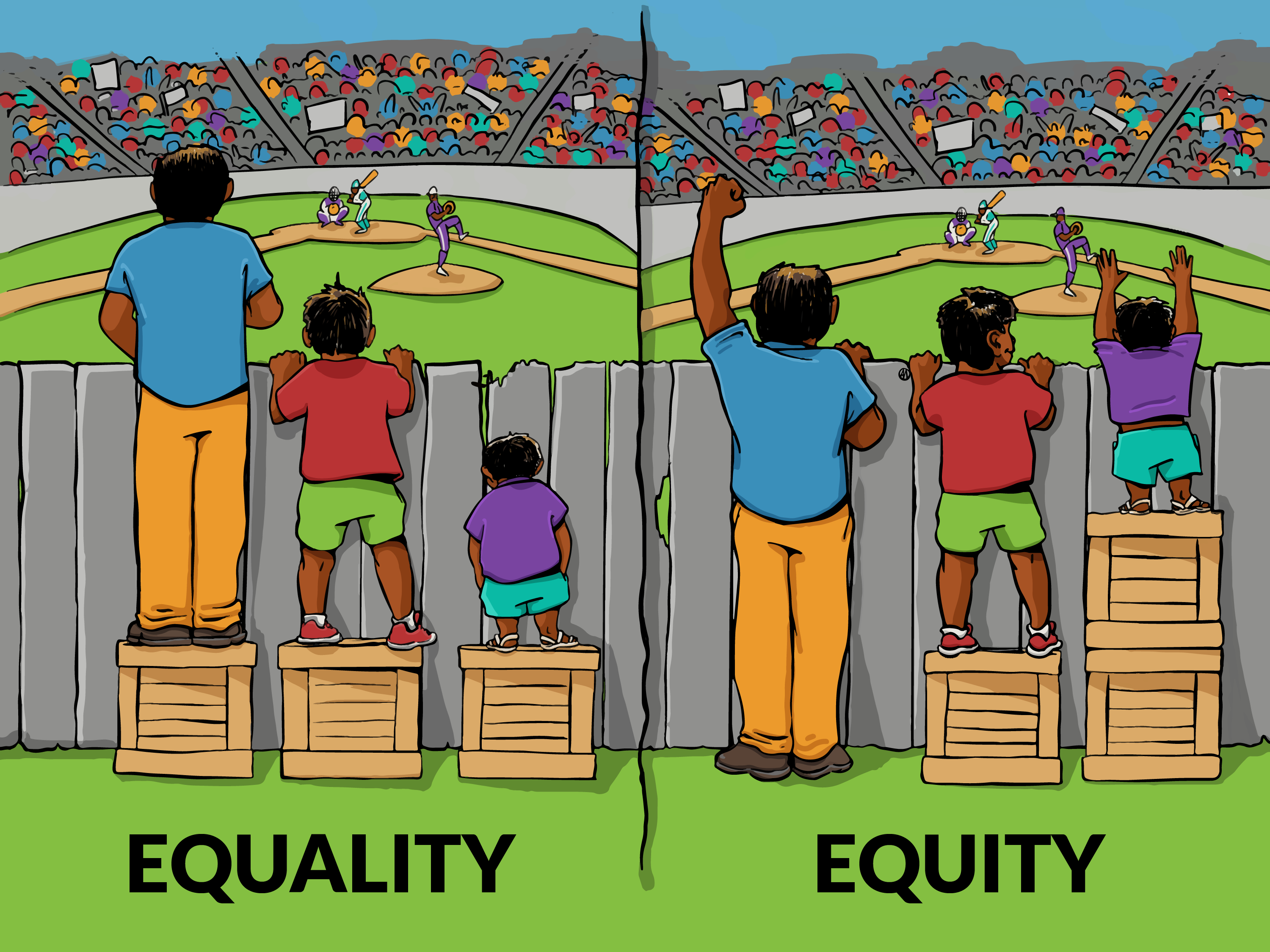
Once that happens, I know my students are ready for the second image:

IISC_EqualityEquity
Source: http://interactioninstitute.org/wp-content/uploads/2016/01/IISC_EqualityEquity.png

This is the first time many students will interact with the word equity, so we discuss it in context of fairness, a word they already know. We discuss the situation students would prefer to be in. I ask whether or not they believe that it is okay for the people on the right to have extra support.

When I then ask students to reflect on where they see this in their personal lives, many of them draw on relationships with their siblings. They talk about times when they weren’t necessarily treated equally (i.e. being responsible for different chores) but they do understand how they were being treated fairly (i.e. everyone had a chore, but you can’t expect the youngest sibling to walk the dog alone).

Students also talk about their school experiences, often using each other as examples. One of my English language learners last year pointed to his best friend and said, “I think Daryl is super lucky because he can use a translator for the test but I’m really the one with an advantage because my English ability is better than his. If Daryl didn’t have the translator, the test wouldn’t actually show what he knows about the topic. It would just be another language test.”

That’s precisely the point.

Students are very, very practiced at seeing the differences between themselves and their peers. They miss relatively little. Giving students the words to talk about what they’re seeing allows them to understand why there are differences in the ways teachers approach different members of the class. It also helps them understand the purpose and necessity of government policies that provide aid to certain groups of people in a variety of contexts.

Addressing Opposing Arguments

I have always had students who argue that giving each student in the room the same test is the only way to truly be objective and unbiased in finding out who knows the most. (In case you were unsure, I am against everything that resembles a traditional sit-silently-and-race-the-clock model of filling in bubbles to find out what students know.)

Since I work really hard to cultivate students’ individual voices in the classroom, I can usually rely on other students to challenge this position and provide evidence that helps the rest of the class develop more nuanced understandings of fair and equal. Depending on the age level of the students and the political bent of the school (unfortunately, this is actually important to be aware of) I may choose to segue this discussion into politics and economic policies, specifically addressing facts and myths surrounding public assistance.

However, in school environments where educators’ academic freedom is more limited or with younger students, it is generally more productive to pose a version of the following question: How can we find out what students know in ways that are fair rather than equal?

I have found that reframing the conversation around fairness, rather than letting students get hung up on their understanding of objectivity, is the more useful discussion. It challenges students to focus on what different individuals need to be successful, while also providing them with an opportunity to talk about formative and summative assessments that think best allow them to demonstrate their knowledge.

Why It Matters

Each student brings a unique background, perspective, set of circumstances, hopes, dreams, and experiences to the classroom. Assuming that an individual student needs exactly what his or her classmates need is harmful not only to the student, but to the rest of the class, as well. Some students need breakfast before we can expect them to learn, while others need additional learning activities to reinforce what they did in class that day. Still others need more difficult questions to consider that help them understand information in a more complex way.

Considering all of these student needs and coming up with one set of activities, one set of questions, one homework assignment, and one assessment might mean that we are treating all students equally.

But in doing so, we would not be treating them fairly.

I am not saying that we need a different lesson plan for every student. What I am saying is that we need to carefully consider what our students need to be successful, and we need to adjust accordingly. We need to take into account who our students are and where they come from. Ignoring all of this and assuming a tabula rasa model of the mind does a disservice to students’ individuality and diversity.

Conclusion

Differentiation takes time, practice, and collaboration with colleagues. It means preparing multiple modes of exploring and interacting with new ideas and concepts. It also means providing variety or choice in assessment of knowledge and learning.

The more differentiation students see in the classroom, the easier time they will have discussing and exploring the difference between fairness and equality.

I believe this is an important conversation to have with students because it draws on their experiences in and outside of the classroom and will prompt them to look around at their world. Students will begin to see circumstances in which fair does not mean equal and circumstances in which equal is actually harmful.

Encouraging students to question what they see is a key part of working to make the world a better place for all. Change is certainly possible, but not if we don’t point out what needs to change. We need to encourage the questions, help students evaluate solutions, and take into account what differences exist and why. Being open to these discussions is necessary for developing a better, more peaceful world


And speaking of being open to discussion . . . If you’ve had similar conversations with students, I’d love to hear about them. Other ideas on differentiation or fairness in the classroom? Comment below!

Finding Congruence

As the tagline of this blog suggests, I have one primary goal and that is to make the world a better, more peaceful place. Much nonfiction reading (see the end of this post) over the last six months has led me to question how to maximize my personal well-being while also being the best person I can for those around me. Finding a balance between these two goals matters if we aim to improve the world for all of those who inhabit it. I propose that we should consider identity as what makes us human, rather than what makes us individuals. Thinking about it like this, I hope we can better act in ways that benefit others while also remaining honest with ourselves. This post attempts to explain how I’m attempting to find congruence personally and professionally in who I am, what I do, and who I want to be.

Defining Congruence

When I was a child, my parents posited difficult choices as having two possible options: What is right or what is easy. As an adult, I understand that it is not so simple. Choices are far more complex than right or easy. We make choices in terms of what is good for others or ourselves, what will make different stakeholders the most happy, what causes the least amount of harm, and what most aligns with how we see ourselves.

Most importantly, we make the choices that we hope will increase our overall well-being. Doing so should involve consideration of not only ourselves, but also of others so that we are aiming to improve the world as a whole, which will have a positive impact on our own lives.

This is congruence – alignment in how you describe yourself, see yourself, and the actions that you take.

The difficulties, then, are not between right and easy (sometimes the right choice is easy, but not our preference). I see two difficulties here:

  1. In situations where self and other interests clash, how to cultivate an identity that benefits others without compromising ourselves
  2. What to do when there is dissonance between how we see ourselves and the choices we make

Difficulty 1: Developing Identity
There are certainly situations where personal desires do not square with the needs or desires of those around us. Let’s consider the example of a materialist (identity) who steals in order to obtain more and more (action, generally considered “bad” because it harms others and therefore condemned by society). There is clearly congruence here, but do these actions ultimately lead to greater life satisfaction? Research says no, more possessions do not lead to greater happiness. If the materialist is aiming for increased well-being, there are avenues other than acquisition that will be more beneficial.

Identity should reflect not only who you are now, but what you want for the future. If you want to be happy, you are better off taking actions that are empirically proven to increase well-being overall. Congruence that is a result of careful consideration of goals and desires and how to meet them is more likely to increase satisfaction both for oneself and for those around us, particularly by avoiding actions that cause harm.

Difficulty 2: Dissonance Between Self-Image and Choices
Again, there are situations where we are forced to make choices with options that we don’t like. People have a tendency to blame the people who put us in those situations, which really only increases our personal sense of injustice, therefore causing more harm to ourselves than to anyone else.

The better option is to reflect on our chosen identity. If I see myself (or want to see myself) as a supportive friend, for example, I need to make choices that demonstrate my support. I need to attend the lunch at an inconvenient time, host the bridal shower, or make a difficult phone call. My actions need to demonstrate my support, regardless of how satisfied or happy that choice will make me. I may not want to host the bridal shower because it’s expensive and time-consuming, but a supportive friend would host the bridal shower. The satisfaction that I ultimately feel is a result of the congruence created by aligning identity and behavior.

Personal Congruence

When actions and identity do not match, dissonance arises. In some circumstances, being satisfied with dissonance is appropriate and acceptable. Many people pursue hobbies for sheer enjoyment, pleasure, or connection with others and have no desires or hopes to turn those hobbies into professions. Calling yourself a chef because you enjoy cooking for your family might be an example of dissonance, but they are also two aspects of a larger identity in which you care for those around you.

Dissonance becomes a problem, however, when it interferes with or contradicts the development of a desired identity because of actions taken around it. With the larger choices that I’ve made, I’ve chosen to address the dissonance that arises when I recognize that my actions and identity are misaligned.

For purposes of example, a timeline to my vegetarianism:

  • 2008 – Stopped eating red meat (except when my mother made certain dishes for the holidays)
  • 2009 – Stopped eating poultry at restaurants but still enjoyed it at home
  • 2011 – Stopped eating red meat entirely
  • 2012 – Stopped cooking poultry for myself but would eat it if someone else made it
  • 2015 – Stopped eating poultry entirely
  • 2016 – Stopped eating fish from fisheries or farms that are not certified and vetted as sustainable

Why?

First, I realized that I didn’t like meat or poultry very much and reduced consumption as a result. (This is also a good time to disclose that I grew up in and maintain a kosher household, which means food restrictions have always been part of my life.) When I realized that I didn’t miss red meat and hardly touched it during holidays, I eliminated it entirely.

Second, I started reading a lot about what food is, where it comes from, and how culinary practices have evolved over time. Kitchen Literacy and Eating Animals impacted my decisions around poultry and I began thinking a lot about what human omnivorism means for the environment, which humans are depleting, and for animals, which are sentient beings. I grew uncomfortable (this is where dissonance comes in!) as I nodded and agreed with everything Vileisis and Foer said and then cheerfully enjoyed a turkey burger. By the time I moved to Malaysia in 2014, I had recommended both books to other people and largely developed an identity as a most-of-the-time vegetarian whose food choices impacted social outings.

Yet, I slipped back to old habits when avoiding both red meat and poultry grew challenging, particularly when I traveled. If vegetarianism impacted my food choices at home and at the restaurants my friends and I visited, was it important enough to impact my travels? Is there an off-switch for caring about sentient beings and maintaining an environment that can sustain human and animal populations? I didn’t think so.

Ultimately, it was more reading (examples include The Age of Sustainable Development, Altruism, and The Art of Happiness) that made me realize that all of the many actions I’d always taken to practice environmentalism paled in comparison to my eating habits and my status as a very frequent flier, which actually had a much greater impact on the environment. It didn’t make sense (dissonance again!) that, as someone who carried around paper coffee sleeves and plastic water bottles until a recycling bin appeared, I happily participated in decimating the world’s fish population.

Again, there was dissonance in how I described myself (as a vegetarian), saw myself (as an individual conscious of sustainability), and what I did (bought and ate fish with no regard for what the food on my plate meant for the ocean and river ecosystems).

It’s a relatively simple example. Choosing vegetarianism has been such a gradual process for me that it’s not even life changing at this point. What is life changing, however, is that I finally feel that my food choices reflect the person I consider myself to be – someone who cares for our planet and all sentient life.  

That being said, I have not chosen to reduce the flying that I do. I find so much value in the experiences that I have when I travel, and firmly believe that I am a better person for doing so. By committing to vegetarianism, I am approaching care for the planet and for sentient life with a “do what you can” mindset. I’m okay with that for right now.

Professional Congruence

I’ve also been thinking about my identity as an educator. I consider myself a good teacher not because I’m confident in my content and pedagogy (though I am), but because I am constantly learning, innovating, and reflecting. I see learning as a huge part of what makes a good teacher. Similarly, I see a willingness to try as a huge part of what makes a good student. While I do tell that to my students, it’s not always on display in my own life. Teachers (and I am guilty of this, too) sometimes hide behind the tried-and-true. We don’t always like to take chances for fear that a new project, topic, or type of technology will expose what we don’t know. (And yes, sometimes the tried-and-true really is the most effective way.) Yet we expect our students to warm to challenges on a daily basis. We want them to be excited about new ideas and ways of showing their knowledge. We want them to ask questions and seek out answers.

But we don’t always show them that we, the older and more experienced learners among them, do the same.

During the past school year, I made a variety of changes to my teaching that I felt better reflected how I view my role as an educator. It wasn’t enough to tell my students that I believed learning was a vital element of teaching; I had to show them. I had to demonstrate that I was learning with them and from them if I wanted to develop a true community of learners in my classroom.

This is part of my continuous search for congruence between my identity (educator) and the actions (learning) that were crucial to education. I recognized a case of “Do as I say, not as I do” for what it was – dissonance between identity and behavior.

I’ve found it helpful to share with students what I’m reading, whether it’s a book, article, blog, or Facebook post. I’ve told them about research I’ve done to prepare a lesson, and about where I struggled to answer my own questions. I’ve made my learning part of my teaching in a way that students can see it. In doing so, I’m trying to find congruence between identity and action, and it feels increasingly more comfortable.

Conclusion

I no longer think about choices as binaries – what is right vs. what is easy. Instead, choices are about questions: Who do I claim to be? Who do I want to be? What does option X say about who I am? Does option Y better align with my personal goals?

Keeping these questions in mind, particularly about who I want to be, is a helpful guide for how to act when I recognize that my self-proclaimed identity and actions are incongruent. Rather than being angry or frustrated with a challenging situation, it is far more productive to return to the question of identity.

Who do I want to be?

It might be easier for me to have the hamburger or decline to host the bridal shower, but not if I call myself a vegetarian or environmentalist or supportive friend. It’s not about the right choice (after all, eating the hamburger means supporting an industry that employs a lot of people). It’s about seeking congruence between identity and action and recognizing dissonance for what it is – that uncomfortable feeling of misalignment that is no one’s fault. Rather than being frustrated with the options and doing (spitefully and irritably) what is “right”, do what aligns with who you want to be to the extent that it will increase overall well-being.

As Albus Dumbledore rightly points out, “It is our choices that show what we truly are, far more than our abilities.”

My goal every day is to be better than I was the day before. Being better, for me, means being able to improve the world around me. Working towards this goal is what gives me the greatest congruence, thus increasing life-satisfaction and therefore overall well-being.

Further Reading

For the curious among you, below is a list of many of the books I’ve read in 2016 that have impacted my thinking, my goals, and my actions. It’s likely not exhaustive and some might actually be from late 2015, but I honestly can’t remember!

Nonfiction
The Age of Sustainable Development – Jeffrey Sachs
Altruism – Matthieu Ricard
The Art of Happiness – Dalai Lama and Howard Cutler
Being Peace – Thich Nhat Hanh
Collapse – Jared Diamond
The Consolations of Philosophy – Alain De Botton
Creating Capabilities – Martha Nussbaum
Daring Greatly – Brené Brown
Doing Good Better – William MacAskill
Inside Coca-Cola – Neville Isdell and David Beasley
On Writing – Stephen King
Peace Education – Nel Noddings
Zen in the Art of Writing – Ray Bradbury

Fiction
11/22/63 – Stephen King
The Beautiful and Damned – F. Scott Fitzgerald
The Brothers Karamazov – Fyodor Dostoyevsky
The Course of Love – Alain De Botton
The Dharma Bums – Jack Kerouac
John Dies at the End – David Wong
The Martian Chronicles – Ray Bradbury
Mister Pip – Lloyd Jones
People of the Book – Geraldine Brooks
Rabbit, Run – John Updike
Sharp Objects – Gillian Flynn
This Side of Paradise – F. Scott Fitzgerald

For Good

At times of goodbye, the song “For Good” from the musical Wicked plays on a loop in my head. When I was in high school, the seven senior girls in my choir sang, recorded, and performed a really beautiful SSA rendition that I’m listening to as I write this. Those words were as true in 2008 as they are in 2016.

Today was a hard day.

Today I said goodbye to my school and to so many wonderful, inspiring educators and friends. They said some nice things. I said some nice things. Except for losing the ability to speak (and breathe) during a goodbye “speech” that I had to give about a particularly close friend, I held myself together okay.

I have done so much growing this year, thanks to all of them.

I’ve heard it said
That people come into our lives for a reason
Bringing something we must learn
And we are led
To those who help us most to grow
If we let them
And we help them in return
Well, I don’t know if I believe that’s true
But I know I’m who I am today
Because I knew you

Thank you to those who taught me MYP, DP, ATLs, LOs, and SOIs; how to grade out of 7; who to go to for help about this, that, or the other; how map units in Atlas; when to speak up and when to sit and listen; how to avoid crossing the field in the rain; what to do in case of chaos, disaster, or mosquito bites on camp.

It well may be
That we will never meet again
In this lifetime
So let me say before we part
So much of me
Is made of what I learned from you
You’ll be with me
Like a handprint on my heart

Thank you to those who I looked forward to seeing on the mat every Tuesday; who were always excited for the hawker on Friday; who came to lunch with a story, a quip, and a comment for everything; who seriously answered and encouraged even the most naïve questions; who challenged and supported; who laughed at me sometimes and with me always.

Who can say if I’ve been
Changed for the better?
I do believe I have been
Changed for the better

Thank you to those who have touched my life this year.

I am a better person, educator, and friend for having known you. Thank you for the part you have played in this adventure.

The world itself is a big place and I am lucky enough to have friends in a lot of those places. None of us is a stranger to distance, choices, messaging apps, or long plane rides. I’ll see you again, in your country (wherever that is) or mine (wherever I end up).

Until then, thank you, from the bottom of my heart. I’m so glad to have met you.

Because I knew you
I have been changed for good

Wishing you all the best in your lives and your journeys, now and always.