Category Archives: On My Mind

Rainy Sunday

Today is cold, gray, and wet. I bundled up in my navy raincoat, plaid scarf, and flowered Doc Martens I’ve had since college and I was still cold. The air was full of the dampness that goes straight to the bones. After two years in Southeast Asia, I’m not so good at damp or cold. That’s going to take some practice. Nothing like trial by fire, right? (Except in this case it’s trial by rain.)

Today is also lonely. I woke up knowing I would spend the day by myself, which is fine when that’s what I want to do. When I want to be around people, engage in meaningful conversation, and share myself with others I find it very difficult to be in own company. That’s the kind of feeling I had today when I woke up, which took me by surprise because I spent almost all of yesterday with a friend.

I fought the urge to cuddle back underneath the sheets when my alarm went off just to shorten the amount of time I’d have to spend alone. But I’ve been down this road before so I know better than that. I forced myself out of bed and outside for a quick, cold, wet run. Did yoga to return some heat to my joints. Left the house.

That’s key. Leave the house. It’s easy to get trapped in a cycle of rumination and distasteful self-pity when alone in my apartment. When I’m out, even when I’m out by myself, there are people to watch, conversations to overhear, places to go.

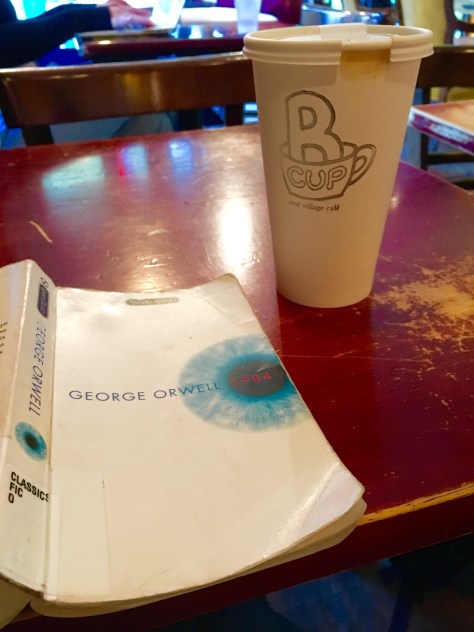
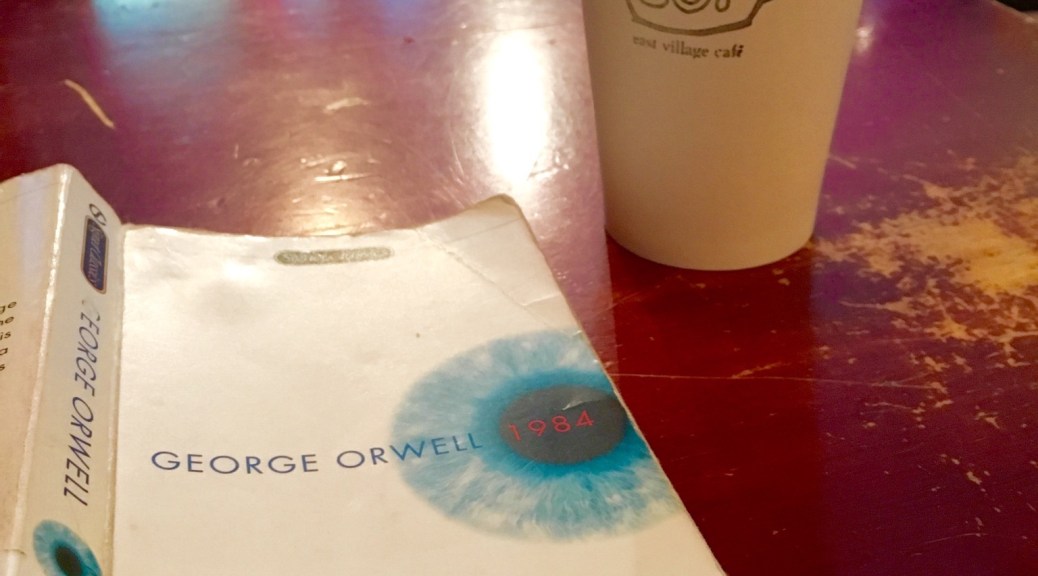
Made my way to the library to pick up George Orwell’s 1984. I’ve never read it and although I’m in the middle of two other books right now (What Kind of Creatures Are We? by Noam Chomsky and How Happy Became Homosexual by Howard Richler) today felt like a “curl up with a novel” sort of day. That’s something I’m always happy to do alone.

And by alone I mean in the company of strangers and a cup of coffee at B Cup Café in the East Village.

img_0183
I certainly wasn’t the only one waiting out the rain with a hot beverage!

The music, atmosphere, and food options were good enough for me to order a second coffee and a breakfast wrap for lunch. Breakfast is delicious at all times of day.

That’s when I ran into the problem of what to do next. There’s only so much caffeine one can drink in a day. And I’m bad at sitting.

So I headed home. Stopped at the farmers’ market to pick up some things on the way. Put on Bon Iver’s new album (again). Thought about all the times over the past 12 months that I’d been lonely and told myself all that would end when I moved to New York.

Thought about how wrong I was.

On the bright side, I’ve had a lot of time to think. Time that I desperately needed. I don’t know whether I’m in a better place now than I was in August, but I do know that I’m in a different place. That’s definitely a step in the right direction, though I don’t know what direction that is.

Maybe this time alone will help me figure it out.

On Beauty

“Will you still love me when I’m no longer young and beautiful?”

With that song playing in the background as I write this, I am struck by the sadness that minor chords inspire. It is that feeling of sadness that keeps me drawn to Lana Del Rey’s piece, which I recently learned was written for Baz Lurhmann’s 2013 adaptation of The Great Gatsby. I very often have a song in my head that echoes what I’m doing, where I am, or how I’m feeling. There are songs I associate with certain emotions, people, or places and they arise unbidden very much like songs on a film soundtrack. Ask me about it sometime and I’ll happily tell you what’s playing!

The refrain I’ve been hearing lately is linked above. I’m actively listening to it on repeat in an effort to get it out of my head and shut off the demons that come with it. But they’re insistent, which is why I’m writing this.

Beauty Then
When I was around fourteen, I walked by a mannequin in a store and sighed aloud that it would be nice to be a mannequin when I grew up. My mum and sister pounced on this and I defended myself by saying that I just wanted someone to pick out my clothes.

Admission: That wasn’t entirely truthful.

As a teenager, around the time I was seriously crushing on a boy or two or three, I was very conscious of how I looked. My eyeliner was too dark when I was finally allowed to wear it and I spent too much time worried about my non-existent hips and how my jeans made my bum look. Finding a bathing suit was torturous and I was never happy with my hair so I straightened it for a few years before finally cutting it all off to start over.

In high school, I would have described myself as “pretty” or “attractive” and maybe even “pretty attractive” on a good day. At the same time, I would have described all of my friends as “beautiful”. Being beautiful meant a lot of different things to me, even then, though it took years to develop the confidence to describe myself that way.

Being Beautiful
So what does it mean to be beautiful?

It means being creative and inquisitive. There is certainly such a thing as a beautiful mind.

It means being compassionate, kind, and caring. I’m lucky to know more than a few truly beautiful souls (stay with me for the moment, even if you don’t believe in souls).

Being beautiful also means being strong, healthy, and physically fit.

Beauty means happiness. A smile is just about everyone’s best feature, especially when it’s unexpected.

It means being able to listen to others and appreciate what they have to offer.

It means confidence. It means being able to stand in front of others unapologetically and express ideas, especially when people listening will disagree.

But bubbling underneath all of those examples of real beauty is the far more superficial and completely unattainable image of a supermodel. As Lana Del Rey asks, “Will you still love me when I’m no longer young and beautiful?” According to that question, what matters? Youth matters. Beauty matters. That’s what yield love. Looking at pop culture, love is what matters.

You want love? You need to be young and beautiful.

Or so I thought.

The Shift
My conception of beauty underwent a fundamental shift during my first year teaching. I was teaching one section of a psychology elective and my department head and mentor was teaching the other. He suggested I show Jean Kilbourne’s documentary Killing Us Softly 4 (read about it here or purchase it here) during our unit on gender.

Jean Kilbourne discusses the ways in which advertising views women and uses ads that she has collected over the years to explore society’s obsession with physical appearance, thinness, whiteness, and youth. She argues that we have accepted cutting women into parts and displaying only legs or lips or torso, which dehumanizes women and leads to sexual violence. Kilbourne also delves into the role that Photoshop plays in creating an impossible ideal for both women and men.

Had I been exposed to such a stark analysis of the media and its advertisements in high school, I would have been a lot more confident in who I was rather than worrying about what I looked like. That is not an exaggeration.

As part of a follow-up assignment, my students and I started looking at ads. These already confident students at an all-girls secondary school brought in catalogues they received in the mail, constructively criticized the Victoria’s Secret Fashion Show that was on that week, and put together a variety of pieces reflecting on their experience with the film. I don’t know for sure whether it changed their outlook on beauty, but I do know that it made them think about who they were and who they were told to be.

Beauty Now
It has been a while since I was first allowed to wear eyeliner at 15. My hair is curly and I don’t own a straightening iron, my favorite makeup item is purple mascara, and my jeans are comfortable. End of story.

The unnerving soundtrack in my head, however, still playing the Lana Del Rey song, has made it clear that I am not without insecurities. I am far more adept at seeing beauty of any kind in others than I do in myself. Maybe this is because I’m a lot harder on myself than those around me.

The chorus of the song ends with, “I know you will.” The irony is that she still had to ask, as many of us do.

Seeing myself as beautiful now, though it sometimes requires effort in self-compassion, means accepting myself as I am and for who I want to be. It involves living up to the ideal that I have created for myself as one who is continuously learning and acting to make the world a better place. Considering myself beautiful means placing the greatest value on how I treat those around me and what I do to improve the world.

Are you beautiful? You are, in so many ways. The beauty that actually matters does not diminish with age. If anything, it is likely to grow along with you.

Building Peace: What’s Missing in the Definition

It has recently come to my attention that my use of the word “peace” extends far beyond the colloquial definition of “nonviolence”. A friend suggested that I write about my broader view of peace in order to provide context to my blog posts on peacebuilding in the classroom. So far, I’ve written about building peace as the purpose of education, redefining masculinity and femininity, use of words and language around students, and specific classroom situations that highlight the need for increased attention to peace. The purpose of this post is to clarify what peace means to me and how I envision a better, more peaceful world.

Definition
When I asked my students to define the word peace, most of them replied that peace means nonviolence, or the absence of war. They’re only partially correct. Merriam-Webster defines peace in four ways:

  • a state of tranquility or quiet: as
    • freedom from civil disturbance
    • a state of security or order within a community provided for by law or custom
  • freedom from disquieting or oppressive thoughts or emotions
  • harmony in personal relations
  • a state or period of mutual concord between governments or a pact of agreement to end hostilities between those who have been at war or in a state of enmity

The bolded definitions above are what I see as missing from much of our conception of what peace is and how it plays a role in everything that we do on a daily basis, as well as everything we are. Seeking freedom from disquieting or oppressive thoughts or emotions, whether as an individual or working to do so with others, is a peaceful act. Working towards harmony in personal relations is a peaceful act.

It is those acts that are often missing from our interactions, society, and wider discussion of what it means to develop a peaceful world.

Going Further
I propose expanding this definition, however. I see peace as the keystone in the arch of what comprises a better world.

019
The keystone is the last piece that goes into an arch during construction. The keystone holds the rest of the arch into position and allows it to bear weight. Without the keystone, the arch is unstable and falls. Without peace, we cannot build a better world.

We have to want a society that allows all people to be free from any sort of oppression, far beyond that of thoughts or emotions. That means working to reduce causes of suffering, including poverty, homelessness, preventable disease, hunger, and lack of clean water. The same is true for developing harmony in personal relations. We need to act with kindness, compassion, and caring towards all others, whether we know them or not. This would open the possibility for dialogue as a way of resolving conflicts, which is an aspect of the “nonviolence” definition of peace. These behaviors need to become part of social norms on local and global scales if we want to develop a better world.

A broader definition of peace also requires concern for the environment. The purpose of peace among humanity is to create a world that is better and more sustainable than the world we have today. Being peaceful in actions towards the environment, working to protect and preserve Earth’s existing resources, and developing technology like renewable energy are all essential components of creating a better world for all. As Planetwalker John Francis explains in his TED Talk, “I learned about people, and what we do and how we are. And environment changed from just being about trees and birds and endangered species to being about how we treated each other. Because if we are the environment, then all we need to do is look around us and see how we treat ourselves and how we treat each other.”

Because if we are the environment, then all we need to do is look around us and see how we treat ourselves and how we treat each other.

Do we treat the environment peacefully? Or are we destructive, harmful, greedy, competitive, aggressive, and violent in our actions towards the planet? What does that say about how we view sentient life?

Peace and Sustainable Development
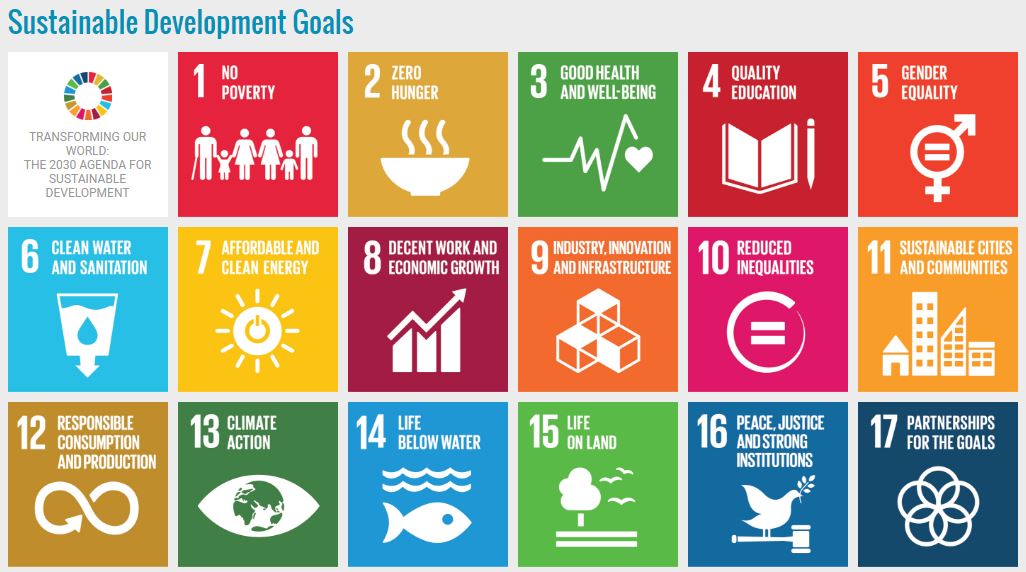
At the end of last school year, I spent a few days discussing the UN Sustainable Development Goals with my grade nine students.

un-sdgs

Pairs of students chose a goal to research. They prepared presentations to teach the rest of the class what their goal means, work in progress towards the goal, and ways that students might be able to get involved in advancing the goal.

The way I see it, all of these goals reflect a peaceful world in which we care about those around us. The state of tranquility or quiet in Merriam-Webster’s definition will be realized when we end poverty and prevent diseases, assure that Maslow’s basic needs are met, and all humanity is guaranteed a financial safety net that provides the freedom to make choices, create, explore, develop, and achieve.

When we decide that we want to develop an age of sustainable development, we are choosing peace. Developing a peaceful world requires us to commit to treating those around us with dignity, and actively work to help all people increase overall well-being. Altruistic action is necessary towards humanity and towards the environment. These are inherently peaceful actions because they support those around us in the aim of improving our world for all. As Matthieu Ricard explains in Altruism, “In essence, altruism does indeed reside in the motivation that animates one’s behavior. Altruism can be regarded as authentic so long as the desire for the other’s welfare constitutes our ultimate goal, even if our motivation has not yet been transformed into actions.” This is how we will build and maintain a better world for ourselves, our children, and the rest of humanity. Choosing peace in this context requires active commitment to developing a sustainable world.

Peace
Truly choosing peace means looking at the world and its people and cultivating an attitude that reflects the messages we want to send. I think of peace as a state of mind and a way of being, which is what I try to explore with my students. It’s not enough to claim that we want peace for our world. We have to act, be, and think peacefully in order to make that world a reality.

That is the world I am working to build. I invite you to join the conversation about how to create our better, more peaceful sustainable world.

There can be no peace as long as there is grinding poverty, social injustice, inequality, oppression, environmental degradation, and as long as the weak and small continue to be trodden by the mighty and powerful. – Dalai Lama